GST-Tag anticorps
 (1 validation)
Aperçu rapide pour GST-Tag anticorps (ABIN3045984)
Antigène
Reactivité
Hôte
Clonalité
Conjugué
Application
Clone
-
-
Attributs du produit
- The GST tag issued in many protocols
-
Purification
- purified form hybridoma supernatant
-
Immunogène
- GST
-
Isotype
- IgG1
-
-
anti-GST-Tag antibody
WB Hôte: Souris Monoclonal 9AT106 unconjugated
anti-GST-Tag antibodyWB Hôte: Lapin Polyclonal RB2165 unconjugated
anti-GST-Tag antibodyWB, ELISA Hôte: Souris Monoclonal 9AT106 unconjugated
anti-GST-Tag (AA 1-218) antibodyReactivité: Différentes espèces WB, IP, DB Hôte: Souris Monoclonal C9 unconjugated
anti-GST-Tag (AA 1-201) antibodyWB, IP Hôte: Lapin Monoclonal BLRE05M unconjugated Recombinant Antibody
anti-GST-Tag antibodyWB Hôte: Souris Monoclonal 25GB7045 unconjugated
anti-GST-Tag antibodyWB, IP Hôte: Souris Monoclonal S-tag-05 unconjugated
anti-GST-Tag antibodyWB Hôte: Souris Monoclonal 25GB7025 unconjugated
anti-GST-Tag (AA 1-218) antibodyReactivité: Différentes espèces WB, IP, DB Hôte: Lapin Polyclonal unconjugated
-
-
Indications d'application
- WB 0.1-1.0ug/ml
-
Restrictions
- For Research Use only
-
-
- by
- Celplor LLC
- No.
- #029860
- Date
- 19.05.2016
- Antigène
- Mouse anti-GST monoclonal antibody
- Numéro du lot
- 1214
- Application validée
- Western Blotting
- Contrôle positif
- BL21 bacteria cells were transformed with an in-house GST expression vector pGST
- Contrôle négative
- Empty vector cell lysate
- Conclusion
- Based on the 12% GST content in total cell lysate of BL21-pGST (+IPTG), there is an estimated 1 ng of GST protein in 0.01 ug of total protein with IPTG induction. Therefore, the detection limit of mouse anti-GST monoclonal antibody is lower than 1 ng of GST protein.
- Anticorps primaire
- Antibody: Mouse anti-GST monoclonal antibody
- Lot number: 1214
- Dilution: 1:1000
- Anticorps secondaire
- Antibody: HRP labeled secondary anti-mouse antibody
- Lot number: 390630
- Dilution: 1:2000
- Full Protocol
- **I. Reagent preparation**
- 1. BL21 bacteria cells were transformed with an in-house GST expression vector pGST.
- 2. Individual colony was inoculated in 2xYT medium and cultured at 37°C with shaking for 5 hrs followed by IPTG (1mM) induction for 2 hrs. Bacteria was grown to OD600=0.6-0.8 (5 hr) when IPTG was added.
- 3. Cells were centrifuged at top speed and pellets were collected.
- 4. Cell pellets were lysed in SDS-PAGE sample buffer.
- 5. Protein concentration was assayed using DC protein assay kit (Bio-Rad).
- 6. 50 ug of cell lysate was loaded and protein was separated by SDS-PAGE.
- 7. Gel was stained with SimplyBlue Safe Stain (Invitrogen) at room temperature.
- 8. GST content in IPTG induced samples was analyzed by Quantity One software (Bio-Rad).
- **II. Western blot validation**
- 1. Cell lysates from BL21 host cells, BL21-pGST transformed cells with or without IPTG induction were loaded and proteins were separated by SDS-PAGE followed by Western transfer to a nitrocellulose membrane.
- 2. Membrane was blocked with 2% powder milk (Bio-Rad) for 1 hr at room temperature.
- 3. Membrane was incubated with mouse anti-GST monoclonal antibody (1:1000 dilution) at 4°C overnight with shaking.
- 4. Membrane was washed with TBST three times for 10 min.
- 5. After washing, membrane was incubated with HRP labeled secondary anti-mouse antibody (1:2000 dilution, GE Healthcare) with shaking at room temperature for 1 hr.
- 6. Membrane was washed with TBST three times for 10 min.
- 7. After washing, membrane was incubated with SuperSignal West Pico substrate (Thermo Scientific) for 5 min at room temperature.
- 8. Membrane was analyzed by ChemiDoc XRS gel documentation system (Bio-Rad).
- Notes
Validation #029860 (Western Blotting)
 Validation Images
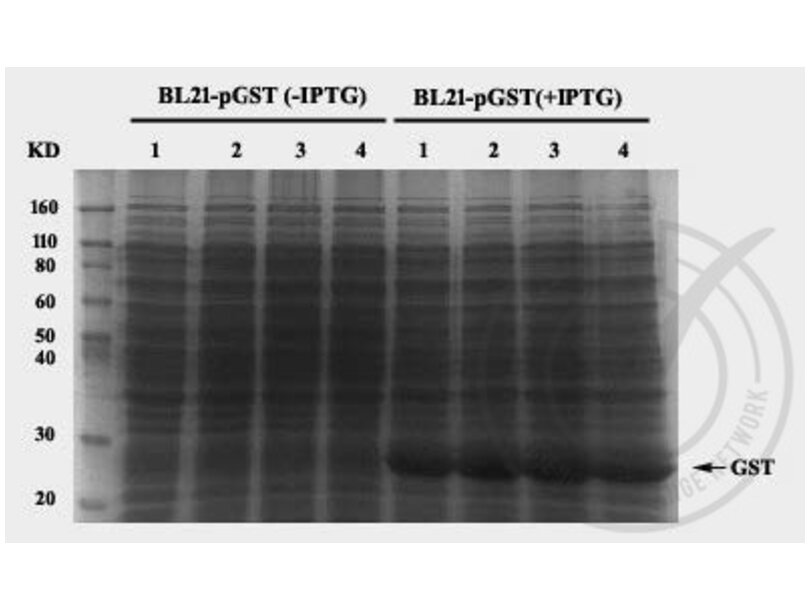
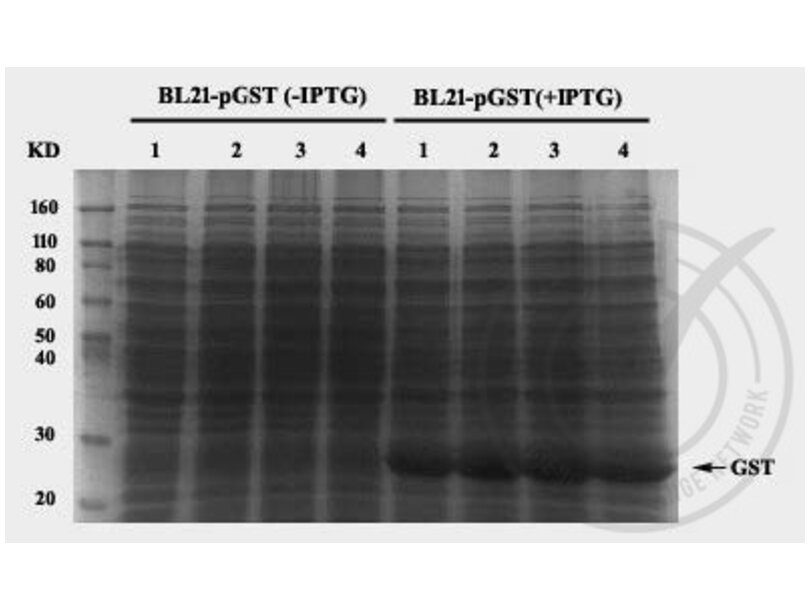
![Figure 1: GST content of BL21-pGST(+IPTG) is 12% of total protein. GST content in IPTG induced samples was analyzed by Quantity One software (Bio-Rad).]() Figure 1: GST content of BL21-pGST(+IPTG) is 12% of total protein. GST content in IPTG induced samples was analyzed by Quantity One software (Bio-Rad).
Figure 1: GST content of BL21-pGST(+IPTG) is 12% of total protein. GST content in IPTG induced samples was analyzed by Quantity One software (Bio-Rad).
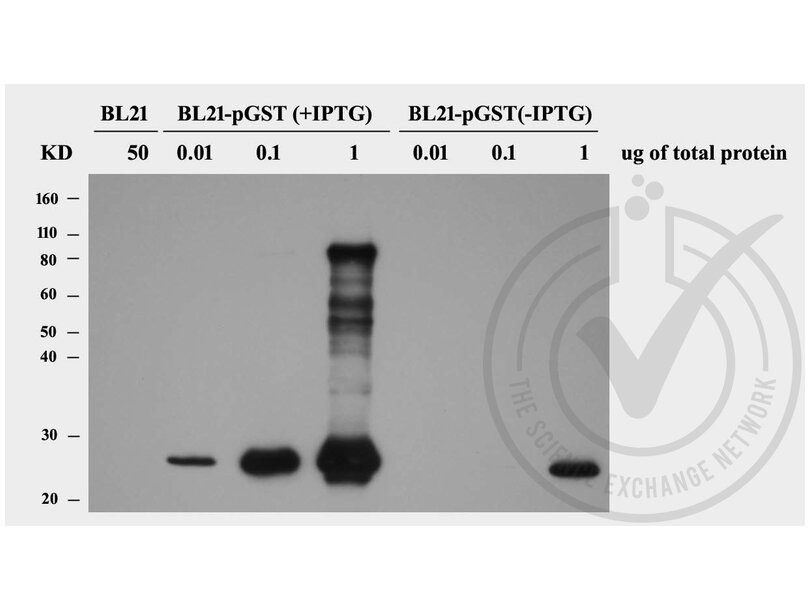
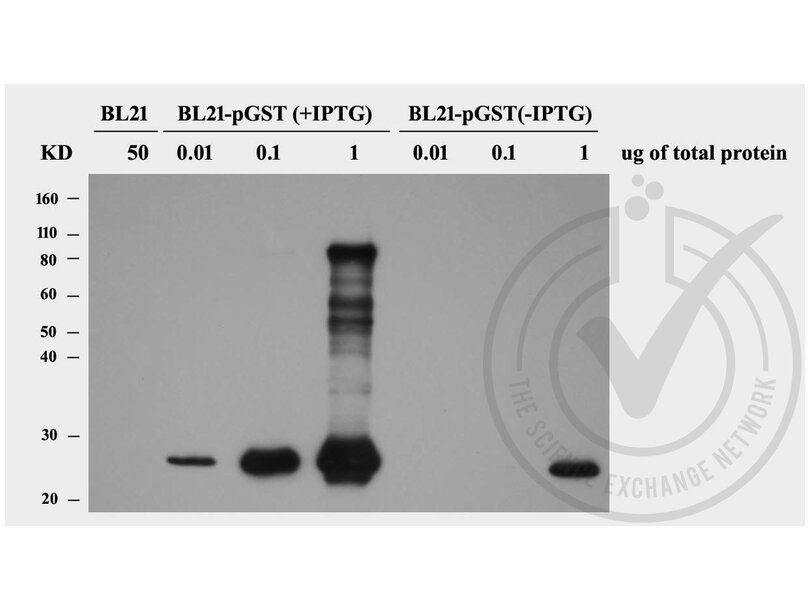
![Figure 2: Western blot for mouse anti-GST monoclonal antibody. The first lane shows the empty vector cell lysate (negative control). This is followed by a 0.01, 0.1, and 1 ug of total protein from BL21-pGST, with (Lanes 2, 3, and 4) or without (Lanes 5, 6, and 7) IPTG induction, respectively.
Based on the 12% GST content in total cell lysate of BL21-pGST (+IPTG), there is an
estimated 1 ng of GST protein in 0.01 ug of total protein with IPTG induction. Therefore,
the detection limit of mouse anti-GST monoclonal antibody is lower than 1 ng of GST
protein. The higher than expected molecular weight may be the result GST dimers or aggregates (Riley et al. Protein Engineering vol.9 no.2 pp.223-23O, 1996).]() Figure 2: Western blot for mouse anti-GST monoclonal antibody. The first lane shows the empty vector cell lysate (negative control). This is followed by a 0.01, 0.1, and 1 ug of total protein from BL21-pGST, with (Lanes 2, 3, and 4) or without (Lanes 5, 6, and 7) IPTG induction, respectively.
Based on the 12% GST content in total cell lysate of BL21-pGST (+IPTG), there is an
estimated 1 ng of GST protein in 0.01 ug of total protein with IPTG induction. Therefore,
the detection limit of mouse anti-GST monoclonal antibody is lower than 1 ng of GST
protein. The higher than expected molecular weight may be the result GST dimers or aggregates (Riley et al. Protein Engineering vol.9 no.2 pp.223-23O, 1996).
Protocole
Figure 2: Western blot for mouse anti-GST monoclonal antibody. The first lane shows the empty vector cell lysate (negative control). This is followed by a 0.01, 0.1, and 1 ug of total protein from BL21-pGST, with (Lanes 2, 3, and 4) or without (Lanes 5, 6, and 7) IPTG induction, respectively.
Based on the 12% GST content in total cell lysate of BL21-pGST (+IPTG), there is an
estimated 1 ng of GST protein in 0.01 ug of total protein with IPTG induction. Therefore,
the detection limit of mouse anti-GST monoclonal antibody is lower than 1 ng of GST
protein. The higher than expected molecular weight may be the result GST dimers or aggregates (Riley et al. Protein Engineering vol.9 no.2 pp.223-23O, 1996).
Protocole -
-
Format
- Liquid
-
Concentration
- 1 mg/mL
-
Buffer
- PBS pH7.2
-
Stock
- -20 °C
-
-
- GST-Tag
-
Autre désignation
- GST Tag
-
Classe de substances
- Tag
-
Poids moléculaire
- 26 kDa
-
UniProt
- P08515
Antigène
-