SYN1 anticorps (AA 362-511)
 (1 validation)
Aperçu rapide pour SYN1 anticorps (AA 362-511) (ABIN5542390)
Antigène
Voir toutes SYN1 AnticorpsReactivité
Hôte
Clonalité
Conjugué
Application
Clone
-
-
Épitope
- AA 362-511
-
Fonction
- SYN1 Antibody
-
Purification
- Purified antibody
-
Immunogène
- Purified recombinant fragment of human SYN1 (AA: 362-511) expressed in E. Coli.
-
Isotype
- IgG1
-
-
anti-Synapsin I (SYN1) antibody
SYN1 Reactivité: Humain, Rat, Souris WB, ELISA, IF, IHC (p) Hôte: Lapin Polyclonal unconjugated
anti-Synapsin I (SYN1) (AA 113-420) antibodySYN1 Reactivité: Souris WB, IHC, ICC, IP Hôte: Lapin Polyclonal unconjugated
anti-Synapsin I (SYN1) (AA 362-450) antibodySYN1 Reactivité: Humain WB, ELISA Hôte: Souris Monoclonal 4H1 unconjugated
anti-Synapsin I (SYN1) (pSer9) antibodySYN1 Reactivité: Humain WB, ELISA, IHC, IF Hôte: Lapin Polyclonal unconjugated
anti-Synapsin I (SYN1) (pSer9) antibodySYN1 Reactivité: Humain, Rat, Souris WB, ELISA, IHC, IF Hôte: Lapin Polyclonal unconjugated
anti-Synapsin I (SYN1) (pSer9) antibodySYN1 Reactivité: Humain, Rat, Souris WB, ELISA, IHC, IF, ICC Hôte: Lapin Polyclonal unconjugated
anti-Synapsin I (SYN1) antibodySYN1 Reactivité: Humain, Rat, Souris, Boeuf (Vache) WB, IHC, ICC Hôte: Lapin Polyclonal unconjugated
anti-Synapsin I (SYN1) (AA 113-420) antibodySYN1 Reactivité: Humain WB, ELISA, IHC Hôte: Lapin Polyclonal unconjugated
anti-Synapsin I (SYN1) (AA 201-300) antibodySYN1 Reactivité: Humain, Rat WB, ELISA, IHC (p), IF (cc), IF (p), IHC (fro) Hôte: Lapin Polyclonal unconjugated
anti-Synapsin I (SYN1) (pSer549) antibodySYN1 Reactivité: Souris WB, ELISA Hôte: Lapin Polyclonal unconjugated
-
-
Indications d'application
-
ELISA: 1/10000
FCM: 1/200 - 1/400
ICC: 1/200 - 1/1000
-
Restrictions
- For Research Use only
-
-
- by
- Akoya Biosciences
- No.
- #104335
- Date
- 20.04.2021
- Antigène
- SYN1
- Numéro du lot
- 151229
- Application validée
- Multiplex Immunohistochemistry
- Contrôle positif
FFPE normal human cortex
- Contrôle négative
Unlabeled control (FFPE normal human cortex)
- Conclusion
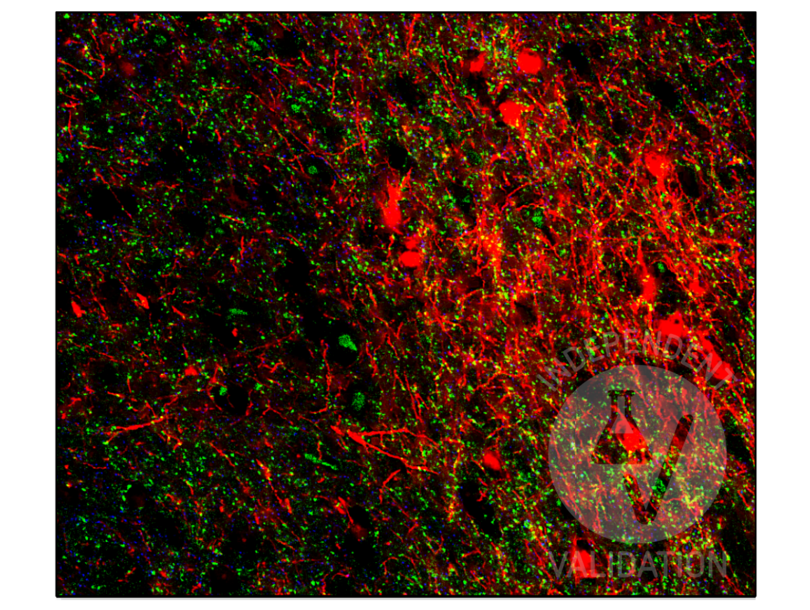
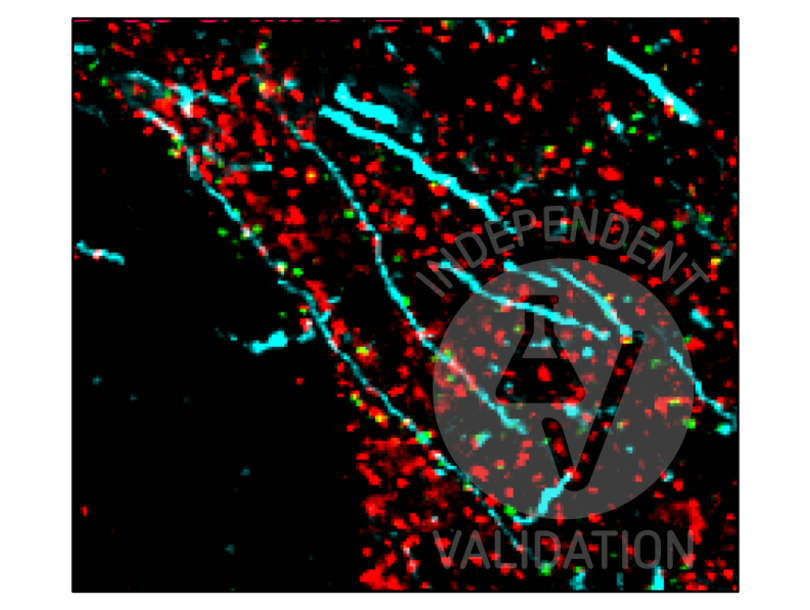
Passed. The anti-SYN1 antibody ABIN5542390 produces punctate labeling in synapse-rich regions of the human cortex. This pattern is consistent with expected SYN1 localization in synaptic contacts.
- Anticorps primaire
- ABIN5542390
- Anticorps secondaire
- Full Protocol
- Protocol details are described in the Akoya Biosciences CODEX® User Manual (see https://www.akoyabio.com/wp-content/uploads/2021/01/CODEX-User-Manual.pdf).
- Tissue preparation as outlined in the Akoya Biosciences CODEX® User Manual fresh-frozen tissue protocol.
- Conjugation of the anti-SYN1 antibody ABIN5542390 to an oligo barcode used to bind oligo-conjugated fluorophore AF488.
- Notes
No signal was detected in unlabeled specimens.
Specific staining of Cortactin was also observed with human FFPE cortical tissue sections with both citrate antigen retrieval and EDTA antigen retrieval.
Optimal staining and signal to noise ratios were obtained if tissue was pre-treated for autofluorescence removal (see https://www.akoyabio.com/wp-content/uploads/2020/07/Customer-Demonstrated-Protocol-Autofluorescence-Quenching-Mar2020.pdf).
Validation #104335 (Multiplex Immunohistochemistry)
 Validation Images
![FFPE normal human cortex tissue section labeled with anti-SYN1 antibody ABIN5542390 (blue; bound to fluorophore AF488) after EDTA antigen retrieval. MAP2 and SLC32A1 were labeled with anti-MAP2 antibody ABIN125739 (red; bound to fluorophore ATTO 500) and anti-SLC32A1 antibody ABIN2855225 (green; bound to fluorophore AF488).]() FFPE normal human cortex tissue section labeled with anti-SYN1 antibody ABIN5542390 (blue; bound to fluorophore AF488) after EDTA antigen retrieval. MAP2 and SLC32A1 were labeled with anti-MAP2 antibody ABIN125739 (red; bound to fluorophore ATTO 500) and anti-SLC32A1 antibody ABIN2855225 (green; bound to fluorophore AF488).
FFPE normal human cortex tissue section labeled with anti-SYN1 antibody ABIN5542390 (blue; bound to fluorophore AF488) after EDTA antigen retrieval. MAP2 and SLC32A1 were labeled with anti-MAP2 antibody ABIN125739 (red; bound to fluorophore ATTO 500) and anti-SLC32A1 antibody ABIN2855225 (green; bound to fluorophore AF488).
![FFPE normal human cortex tissue section labeled with anti-SYN1 antibody ABIN5542390 (red; bound to fluorophore AF488) after EDTA antigen retrieval. MAP2 and DLG4 were labeled with anti-MAP2 antibody ABIN125739 (cyan; bound to fluorophore ATTO 550) and anti-DLG4 antibody ABIN361694 (green; bound to fluorophore ATTO 550).]() FFPE normal human cortex tissue section labeled with anti-SYN1 antibody ABIN5542390 (red; bound to fluorophore AF488) after EDTA antigen retrieval. MAP2 and DLG4 were labeled with anti-MAP2 antibody ABIN125739 (cyan; bound to fluorophore ATTO 550) and anti-DLG4 antibody ABIN361694 (green; bound to fluorophore ATTO 550).
Protocole
FFPE normal human cortex tissue section labeled with anti-SYN1 antibody ABIN5542390 (red; bound to fluorophore AF488) after EDTA antigen retrieval. MAP2 and DLG4 were labeled with anti-MAP2 antibody ABIN125739 (cyan; bound to fluorophore ATTO 550) and anti-DLG4 antibody ABIN361694 (green; bound to fluorophore ATTO 550).
Protocole -
-
Format
- Liquid
-
Buffer
- Purified antibody in PBS with 0.05 % sodium azide.
-
Agent conservateur
- Sodium azide
-
Précaution d'utilisation
- This product contains Sodium azide: a POISONOUS AND HAZARDOUS SUBSTANCE which should be handled by trained staff only.
-
Stock
- 4 °C,-20 °C
-
Stockage commentaire
- Store at 4°C short term. Aliquot and store at -20°C long term. Avoid freeze/thaw cycles.
-
-
- SYN1 (Synapsin I (SYN1))
-
Autre désignation
- SYN1
-
Sujet
-
This gene is a member of the synapsin gene family. Synapsins encode neuronal phosphoproteins which associate with the cytoplasmic surface of synaptic vesicles. Family members are characterized by common protein domains, and they are implicated in synaptogenesis and the modulation of neurotransmitter release, suggesting a potential role in several neuropsychiatric diseases. This member of the synapsin family plays a role in regulation of axonogenesis and synaptogenesis. The protein encoded serves as a substrate for several different protein kinases and phosphorylation may function in the regulation of this protein in the nerve terminal. Mutations in this gene may be associated with X-linked disorders with primary neuronal degeneration such as Rett syndrome. Alternatively spliced transcript variants encoding different isoforms have been identified.
-
Poids moléculaire
- 74.1 kDa
-
ID gène
- 6853
-
UniProt
- P17600
Antigène
-