Histone H4 anticorps (acLys12)
 (1 validation)
Aperçu rapide pour Histone H4 anticorps (acLys12) (ABIN6254899)
Antigène
Voir toutes Histone H4 AnticorpsReactivité
Hôte
Clonalité
Conjugué
Application
-
-
Épitope
- acLys12
-
Specificité
- Acetyl-Histone H4 (Lys12) Antibody detects endogenous levels of total Histone H4 protein only when acetylated at lysine12.
-
Réactivité croisée
- Humain, Souris, Rat (Rattus)
-
Purification
- affinity purification
-
Immunogène
- The antiserum was produced against synthesized peptide derived from human Histone H4 around the acetylated site of Lys12.
-
Isotype
- IgG
-
-
anti-Histone H4 (3meLys20) antibody
Reactivité: Humain, Souris, Rat WB, IHC, IF Hôte: Lapin Polyclonal unconjugated
anti-Histone H4 (acLys5) antibodyReactivité: Humain WB, IHC, IF Hôte: Lapin Monoclonal unconjugated
anti-Histone H4 (acLys8) antibodyReactivité: Humain WB, IHC, IF, IP, ChIP, ChIP-seq Hôte: Lapin Polyclonal unconjugated
anti-Histone H4 (2meLys20) antibodyReactivité: Humain WB, IHC, IF, IP, ChIP, ChIP-seq Hôte: Lapin Polyclonal unconjugated
anti-Histone H4 (3meLys20) antibodyReactivité: Humain WB, IHC, IF, DB Hôte: Lapin Polyclonal unconjugated
anti-Histone H4 (acLys12) antibodyReactivité: Humain, Souris, Rat IHC, IF Hôte: Lapin Polyclonal unconjugated
anti-Histone H4 (acLys8) antibodyReactivité: Humain, Souris, Rat WB, IHC, IF Hôte: Lapin Polyclonal unconjugated
anti-Histone H4 (acLys16) antibodyReactivité: Humain, Saccharomyces cerevisiae, Drosophila melanogaster WB, ChIP, DB, ChIP-seq Hôte: Lapin Polyclonal unconjugated
anti-Histone H4 (AA 2-103) antibodyReactivité: Humain, Souris, Rat, Porc, Boeuf (Vache), Poulet, Cat, Chien, Cobaye, Cheval, Macaque rhésus WB, IHC, ICC, IP Hôte: Lapin Polyclonal unconjugated
anti-Histone H4 (meArg3) antibodyReactivité: Humain WB, IHC, IF, IP Hôte: Lapin Polyclonal unconjugated
-
-
Indications d'application
- WB: 1:500~1:2000 IHC: 1:50~1:200 IF 1:200
-
Restrictions
- For Research Use only
-
-
- by
- Prof. Merighi, Laboratory of Neurobiology, Department of Veterinary Sciences, University of Turin
- No.
- #104615
- Date
- 22.09.2024
- Antigène
- Histone H4
- Numéro du lot
- lk4553
- Application validée
- Immunohistochemistry
- Contrôle positif
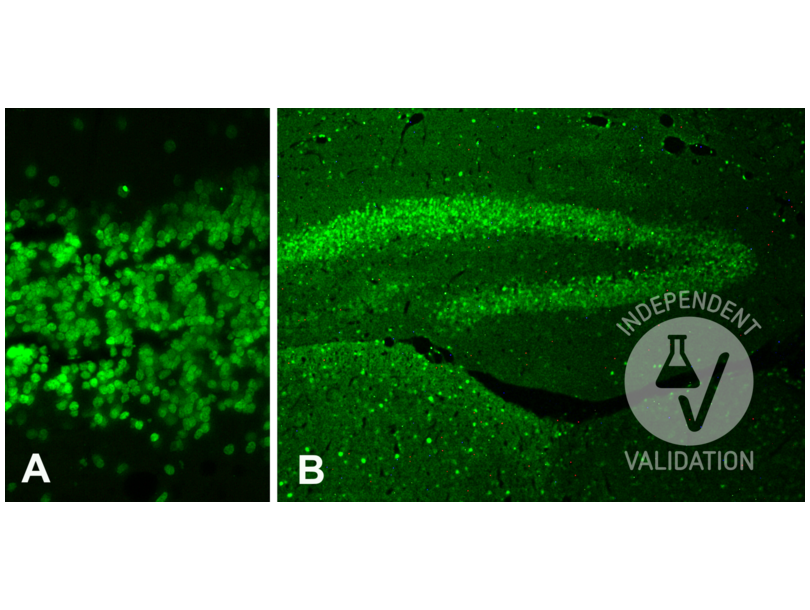
CD1 mouse brain fixed in 4% paraformaldehyde.
- Contrôle négative
Control slices were processed for each experimental procedure, omitting the primary antibody. In this case, overnight incubation was only performed using a diluent solution.
- Conclusion
- Anticorps primaire
- ABIN6254899
- Anticorps secondaire
- Alexa Fluor 488 goat anti-rabbit (Invitrogen by Thermo Fisher Scientific, A11034, lot # 2380031), Alexa Fluor 488 donkey anti-rabbit (Invitrogen by Thermo Fisher Scientific A32790 lot # XJ357262).
- Full Protocol
- SAMPLE ANALYZED: Old (> 18 months) CD1 mouse brain.
- Mice were perfused with paraformaldehyde 4% in 0.1M phosphate buffer (PB) pH 7.4 and samples were post-fixed in the same fixative for 2 additional hours at room temperature. After fixation, samples were washed, dehydrated, and embedded in paraffin wax.
- Following several washes in PBS, the brain was cut with a microtome (6 μm-thick sections) in parasagittal sections mounted on glass slides.
- After paraffin removal, sections were incubated for 1 hour at room temperature in PBS containing 1% albumin from chicken egg white (Sigma, A5378) and 0.3% Triton-X-100 (BioRad, 161-0407, lot # 00583) to block non-specific binding sites. Sections were then incubated overnight at room temperature with the primary antibody anti-Histone H4 (acLys12) (ABIN6254899) at 1:50, 1:100, and 1:200, in PBS-BSA (Sigma, A7906)-PLL (Sigma, P1524).
- Antigen retrieval treatment was also tested. In this case, sections were processed for microwave antigen retrieval for 10 minutes (95–100°C) in 10 mM sodium citrate buffer (pH 6.0). After 20 minutes of spontaneous cooling, sections were washed (distilled water, 2 times for 5 min each; followed by PBS for 5 min).
- Sections were washed 3×5 min in 0.01M PBS.
- Sections were then incubated with the anti-rabbit secondary antibody Alexa Fluor 488, 1:500, in 0.1M PBS, for 1 hour at room temperature.
- Sections were washed 3×5 min in 0.01M PBS.
- Specimens were mounted in Fluoroshield (Sigma, F6182, lot # MKCB0153V).
- Images were acquired with a Leica DM 6000B fluorescence microscope with a digital camera at 20× or 40× magnification.
- Notes
Passed. The antibody works for IHC-P at 1:100 and 1:200 concentrations with or without microwave antigen retrieval. Microwave treatment increases the intensity of staining.
Validation #104615 (Immunohistochemistry)
 Validation Images
![Histone H4 (acLys12) positive nuclei in the mouse brain. A: Immunoreactive nuclei in the granular layer of the cerebral cortex (original magnification 20x). Microwave antigen retrieval. B: Immunoreactive nuclei in the hippocampus. Note the intense staining]() Histone H4 (acLys12) positive nuclei in the mouse brain. A: Immunoreactive nuclei in the granular layer of the cerebral cortex (original magnification 20x). Microwave antigen retrieval. B: Immunoreactive nuclei in the hippocampus. Note the intense staining
Protocole
Histone H4 (acLys12) positive nuclei in the mouse brain. A: Immunoreactive nuclei in the granular layer of the cerebral cortex (original magnification 20x). Microwave antigen retrieval. B: Immunoreactive nuclei in the hippocampus. Note the intense staining
Protocole -
-
Format
- Liquid
-
Concentration
- 1 mg/mL
-
Buffer
- Rabbit IgG in phosphate buffered saline , pH 7.4, 150 mM NaCl, 0.02 % sodium azide and 50 % glycerol.
-
Agent conservateur
- Sodium azide
-
Précaution d'utilisation
- This product contains Sodium azide: a POISONOUS AND HAZARDOUS SUBSTANCE which should be handled by trained staff only.
-
Stock
- -20 °C
-
Stockage commentaire
- Store at -20 °C.Stable for 12 months from date of receipt
-
Date de péremption
- 12 months
-
-
- Histone H4
-
Sujet
-
Description: Core component of nucleosome. Nucleosomes wrap and compact DNA into chromatin, limiting DNA accessibility to the cellular machineries which require DNA as a template. Histones thereby play a central role in transcription regulation, DNA repair, DNA replication and chromosomal stability. DNA accessibility is regulated via a complex set of post-translational modifications of histones, also called histone code, and nucleosome remodeling.
Gene: HIST1H4A, HIST1H4B, HIST1H4C, HIST1H4D, HIST1H4E, HIST1H4F, HIST1H4H, HIST1H4I, HIST1H4J, HIST1H4K, HIST1H4L, HIST2H4A, HIST2H4B, HIST4H4
-
Poids moléculaire
- 11kDa
-
ID gène
- 121, 504, 554
-
UniProt
- P62805
Antigène
-