Histone H4 anticorps (AA 2-103)
 (1 validation)
Aperçu rapide pour Histone H4 anticorps (AA 2-103) (ABIN7440314)
Antigène
Voir toutes Histone H4 AnticorpsReactivité
Hôte
Clonalité
Conjugué
Application
-
-
Épitope
- AA 2-103
-
Fonction
- Polyclonal Antibody to Histone H4 (H4)
-
Specificité
- The antibody is a rabbit polyclonal antibody raised against H4. It has been selected for its ability to recognize H4 in immunohistochemical staining and western blotting.
-
Réactivité croisée
- Cat, Poulet, Boeuf (Vache), Chien, Cobaye, Cheval, Humain, Souris, Porc, Lapin, Rat, Macaque rhésus
-
Purification
- Antigen-specific affinity chromatography followed by Protein A affinity chromatography
-
Immunogène
- Recombinant Histone H4 (H4) corresdonding to Ser2~Gly103 with N-terminal His and GST Tag
-
Isotype
- IgG
-
-
anti-Histone H4 (acLys12) antibody
Reactivité: Humain, Souris, Rat WB, IHC, IF, ELISA, ICC Hôte: Lapin Polyclonal unconjugated
anti-Histone H4 (3meLys20) antibodyReactivité: Humain, Souris, Rat WB, IHC, IF Hôte: Lapin Polyclonal unconjugated
anti-Histone H4 (acLys5) antibodyReactivité: Humain WB, IHC, IF Hôte: Lapin Monoclonal unconjugated
anti-Histone H4 (acLys8) antibodyReactivité: Humain WB, IHC, IF, IP, ChIP, ChIP-seq Hôte: Lapin Polyclonal unconjugated
anti-Histone H4 (2meLys20) antibodyReactivité: Humain WB, IHC, IF, IP, ChIP, ChIP-seq Hôte: Lapin Polyclonal unconjugated
anti-Histone H4 (3meLys20) antibodyReactivité: Humain WB, IHC, IF, DB Hôte: Lapin Polyclonal unconjugated
anti-Histone H4 (acLys12) antibodyReactivité: Humain, Souris, Rat IHC, IF Hôte: Lapin Polyclonal unconjugated
anti-Histone H4 (acLys8) antibodyReactivité: Humain, Souris, Rat WB, IHC, IF Hôte: Lapin Polyclonal unconjugated
anti-Histone H4 (acLys16) antibodyReactivité: Humain, Saccharomyces cerevisiae, Drosophila melanogaster WB, ChIP, DB, ChIP-seq Hôte: Lapin Polyclonal unconjugated
anti-Histone H4 (meArg3) antibodyReactivité: Humain WB, IHC, IF, IP Hôte: Lapin Polyclonal unconjugated
-
-
Indications d'application
- Western blotting: 0.01-2 μg/mL,Immunohistochemistry: 5-20 μg/mL,Immunocytochemistry: 5-20 μg/mL,Optimal working dilutions must be determined by end user.
-
Commentaires
-
The thermal stability is described by the loss rate. The loss rate was determined by accelerated thermal degradation test, that is, incubate the protein at 37°C for 48h, and no obvious degradation and precipitation were observed. The loss rate is less than 5% within the expiration date under appropriate storage condition.
-
Restrictions
- For Research Use only
-
-
- by
- Prof. Merighi, Laboratory of Neurobiology, Department of Veterinary Sciences, University of Turin
- No.
- #104631
- Date
- 04.08.2025
- Antigène
- Histone H4
- Numéro du lot
- A20250716116
- Application validée
- Immunohistochemistry
- Contrôle positif
- Contrôle négative
Control slices were processed for each experimental procedure, omitting the primary antibody. In this case, overnight incubation was only performed using a diluent solution.
- Conclusion
- Anticorps primaire
- ABIN7440314
- Anticorps secondaire
- anti-rabbit Alexa Fluor 488 (Invitrogen A11008, lot # 3112790)
- Full Protocol
- Sample analyzed: adult (9 months old) CD1 mouse brain.
- Paraffin-embedded slices (7µm thick) were deparaffinized and rehydrated through a graded series of alcohols and distilled water (dH2O).
- Sections were blocked in ovalbumin 1% 1 hour at room temperature.
- Antigen retrieval was performed in all the sections by microwave treatment (1 minute at 750W + 1 minute at 250W in Citrate buffer pH 6).
- 3x5 minutes washing in 0.01M PBS.
- Sections were incubated with the primary antibody at the following dilutions of 1:25/1:50/1:100/1:200, overnight at room temperature (primary antibody was diluted in PLL/BSA/PBS diluent).
- 3x5 minutes washing in 0.01M PBS.
- Incubation with the anti-rabbit secondary antibody 1:400 in PLL/BSA/PBS diluent, 1 hour at room temperature.
- 3x5 minutes washing in 0.01M PBS.
- Nuclear counterstaining was performed with 4′,6-Diamidine-2′-phenylindole dihydrochloride (DAPI) 1µg/mL, 2 minutes.
- 2x5 minutes washing in 0.01M PBS.
- Specimens were then mounted in Fluoroshield mounting medium (Sigma).
- Images were acquired with a Leica DM 6000B fluorescence microscope with a digital camera at 63x magnification.
- Notes
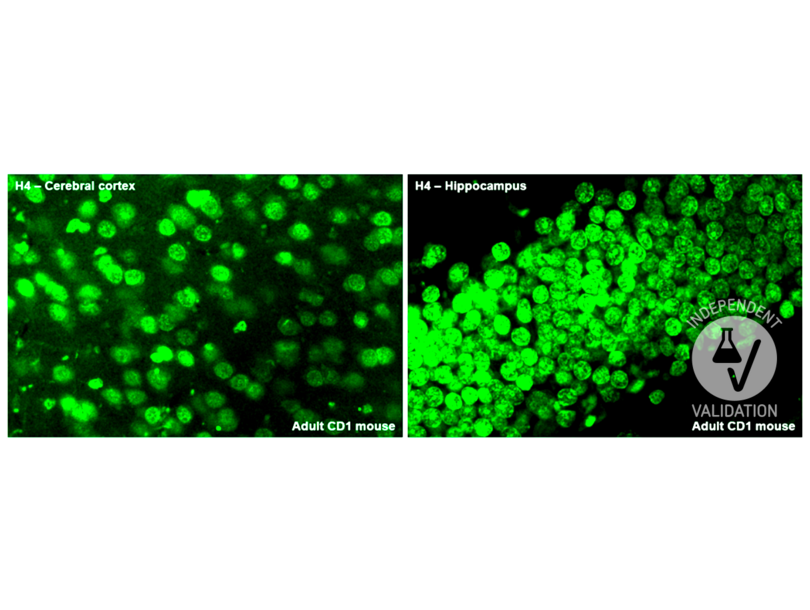
Passed. The antibody works in IHC-P at concentrations from 1:25-1:50.
Validation #104631 (Immunohistochemistry)
 Validation Images
![Histone H4 immunoreactive cells in the cerebral cortex and hippocampus of an adult CD1 mouse. Antibody dilution: 1:25. Magnification: 63x.]() Histone H4 immunoreactive cells in the cerebral cortex and hippocampus of an adult CD1 mouse. Antibody dilution: 1:25. Magnification: 63x.
Protocole
Histone H4 immunoreactive cells in the cerebral cortex and hippocampus of an adult CD1 mouse. Antibody dilution: 1:25. Magnification: 63x.
Protocole -
-
Format
- Liquid
-
Concentration
- 0.33 mg/mL
-
Buffer
- PBS, pH 7.4, containing 0.02 % Sodium azide, 50 % glycerol.
-
Agent conservateur
- Sodium azide
-
Précaution d'utilisation
- This product contains Sodium azide: a POISONOUS AND HAZARDOUS SUBSTANCE which should be handled by trained staff only.
-
Stock
- 4 °C,-20 °C
-
Stockage commentaire
- Store at 4°C for frequent use. Stored at -20°C in a manual defrost freezer for two year without detectable loss of activity. Avoid repeated freeze-thaw cycles.
-
Date de péremption
- 24 months
-
-
- Histone H4
Antigène
-