SSTR3 anticorps
 (1 validation)
Aperçu rapide pour SSTR3 anticorps (ABIN7242716)
Antigène
Voir toutes SSTR3 AnticorpsReactivité
Hôte
Clonalité
Conjugué
Application
-
-
Attributs du produit
- Polyclonal Antibody
-
Purification
- Affinity purification
-
Immunogène
- Synthetic peptide of human SSTR3
-
Isotype
- IgG
-
-
anti-Somatostatin Receptor 3 (SSTR3) (AA 1-43) antibody
SSTR3 Reactivité: Humain, Rat WB, ELISA, FACS Hôte: Souris Monoclonal 7H8E5 unconjugated
anti-Somatostatin Receptor 3 (SSTR3) antibodySSTR3 Reactivité: Humain, Rat, Souris WB Hôte: Lapin Polyclonal unconjugated
anti-Somatostatin Receptor 3 (SSTR3) (C-Term) antibodySSTR3 Reactivité: Humain WB, IHC, ELISA Hôte: Lapin Polyclonal unconjugated
anti-Somatostatin Receptor 3 (SSTR3) (AA 233-246), (Intracellular) antibodySSTR3 Reactivité: Rat WB, IHC, IF Hôte: Lapin Polyclonal unconjugated
-
-
Indications d'application
- IHC 1:50-1:200
-
Restrictions
- For Research Use only
-
-
- by
- Idevall Lab, Department of Medical Cell Biology, Uppsala University
- No.
- #103937
- Date
- 18.06.2019
- Antigène
- SSTR3
- Numéro du lot
- DK1445
- Application validée
- Immunofluorescence
- Contrôle positif
Pancreatic beta cell line MIN6, stained for acetylated tubulin
- Contrôle négative
- Conclusion
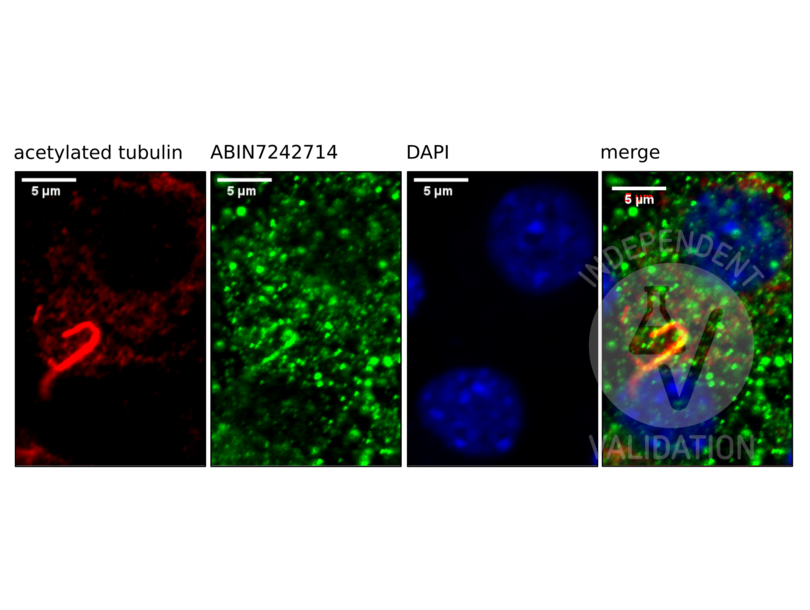
ABIN7242714 specifically labels the targeted antigen in mouse insulinoma cells in IF. No signal was detected in sample negative control tissue and the secondary antibody only control.
- Anticorps primaire
- ABIN7242714
- Anticorps secondaire
- Full Protocol
- Grow MIN6 cells (gift from Prof. Yamamura) in DMEM (ThermoFisher, 41965039, lot 2071491) supplemented with FBS (ThermoFisher, 10500064, lot 08Q6291K) and Penicilin-Streptomycin (ThermoFisher, 15140122, lot 2051356), at 37 °C and 5% CO2 in 2 mL on glass coverslips.
- Starve cells for 48 h in serum free medium to promote ciliogenesis.
- Wash cells with 37 °C DPBS (ThermoFisher, 14190094, lot 2062255).
- Fix cells on coverslips in 4% PFA for 2 min at RT.
- Wash cells 3x for 2 min with PBS.
- Permeabilize cells in PBS containing 0.1% Triton-X for 2 min at RT.
- Block non-specific binding with PBS containing 1% serum for 1 h at RT.
- Incubate cells with primary
- rabbit anti-SSTR3 antibody (antibodies-online, ABIN7242714, lot DK1445) and
- mouse anti-actetylated tubulin (Sigma-Aldrich, T7451, lot 078M4842V) diluted 1:100 in 1% BSA PBS for 2 h at RT.
- Wash cells 3x for 2 min with PBS.
- Incubate cells with secondary
- goat anti-rabbit AF488-conjugated antibody (ThermoFisher, A11034, lot 2069632) and
- goat anti-mouse AF568-conjugated antibody (ThermoFisher, A11004, lot 927620) diluted 1:200 in 1% BSA PBS for 1 h at RT.
- Wash cells 2x for 2 min with PBS.
- Mount coverslips on glass slides in ProLong Gold antifade reagent with DAPI (ThermoFisher, P36935, lot 2086914).
- Image acquisition with Zeiss LSM780, 60x magnification.
- Notes
Our results are consistent with previous studies that have revealed the exclusive expression of SSTR3 in the cilia of mouse pancreatic beta-cells (Iwanaga et al. (2011)).
Validation #103937 (Immunofluorescence)
 Validation Images
![Staining of MIN6 cells with and antibody directed against acetylated tubulin (red, a bona fide marker of the cilium), ABIN7242714 (green) and DAPI (blue). Composite image shows the overlap of red and green staining in the cilium.]() Staining of MIN6 cells with and antibody directed against acetylated tubulin (red, a bona fide marker of the cilium), ABIN7242714 (green) and DAPI (blue). Composite image shows the overlap of red and green staining in the cilium.
Staining of MIN6 cells with and antibody directed against acetylated tubulin (red, a bona fide marker of the cilium), ABIN7242714 (green) and DAPI (blue). Composite image shows the overlap of red and green staining in the cilium.
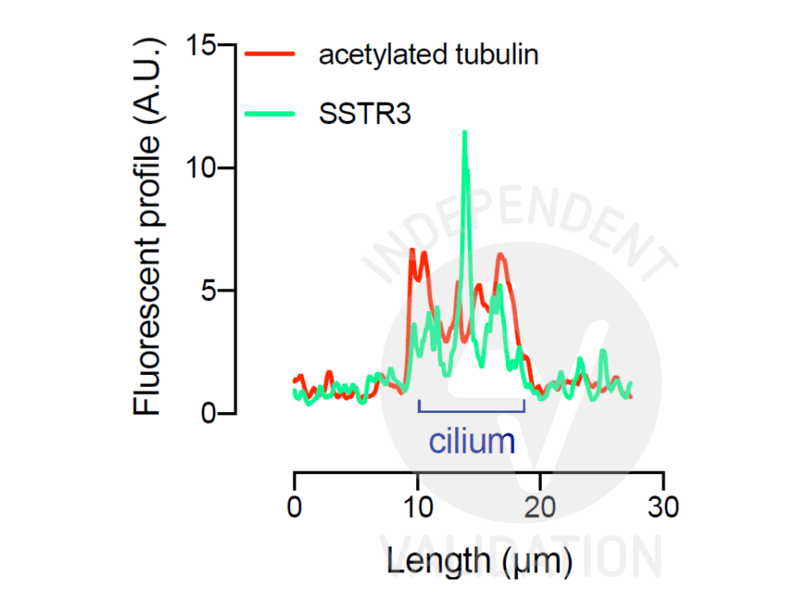
![Fluorescence profiles measured along the cilium of the channels corresponding to acetylated tubulin (red) and SSTR3 (green) confirming enrichment of the receptor in the medial portion of the cilium.]() Fluorescence profiles measured along the cilium of the channels corresponding to acetylated tubulin (red) and SSTR3 (green) confirming enrichment of the receptor in the medial portion of the cilium.
Protocole
Fluorescence profiles measured along the cilium of the channels corresponding to acetylated tubulin (red) and SSTR3 (green) confirming enrichment of the receptor in the medial portion of the cilium.
Protocole -
-
Format
- Liquid
-
Concentration
- 0.4 mg/mL
-
Buffer
- PBS with 0.05 % sodium azide and 50 % glycerol, PH7.4
-
Agent conservateur
- Sodium azide
-
Précaution d'utilisation
- This product contains Sodium azide: a POISONOUS AND HAZARDOUS SUBSTANCE which should be handled by trained staff only.
-
Stock
- -20 °C
-
Stockage commentaire
- Store at -20°C. Avoid freeze / thaw cycles.
-
-
- SSTR3 (Somatostatin Receptor 3 (SSTR3))
-
Autre désignation
- SSTR3
-
Sujet
- Somatostatin acts at many sites to inhibit the release of many hormones and other secretory proteins. The biological effects of somatostatin are probably mediated by a family of G protein-coupled receptors that are expressed in a tissue-specific manner. SSTR3 is a member of the superfamily of receptors having seven transmembrane segments and is expressed in highest levels in brain and pancreatic islets. SSTR3 is functionally coupled to adenylyl cyclase.
-
NCBI Accession
- NP_001042
-
UniProt
- P32745
Antigène
-