Histone H4 anticorps (3meLys20)
 (1 validation)
Aperçu rapide pour Histone H4 anticorps (3meLys20) (ABIN7260402)
Antigène
Voir toutes Histone H4 (HISTH4) AnticorpsReactivité
Hôte
Clonalité
Conjugué
Application
-
-
Épitope
- 3meLys20
-
Attributs du produit
- Methylated antibody
-
Purification
- Affinity purification
-
Immunogène
- A synthetic methylated peptide corresponding to residues surrounding K20 of human histone H4
-
Isotype
- IgG
-
-
anti-Histone H4 (HISTH4) (acLys12) antibody
HISTH4 Reactivité: Humain, Souris, Rat WB, IHC, IF, ELISA, ICC Hôte: Lapin Polyclonal unconjugated
anti-Histone H4 (HISTH4) (acLys5) antibodyHISTH4 Reactivité: Humain WB, IHC, IF Hôte: Lapin Monoclonal unconjugated
anti-Histone H4 (HISTH4) (2meLys20) antibodyHISTH4 Reactivité: Humain WB, IHC, IF, IP, ChIP, ChIP-seq Hôte: Lapin Polyclonal unconjugated
anti-Histone H4 (HISTH4) (3meLys20) antibodyHISTH4 Reactivité: Humain WB, IHC, IF, DB Hôte: Lapin Polyclonal unconjugated
anti-Histone H4 (HISTH4) (acLys8) antibodyHISTH4 Reactivité: Humain WB, IHC, IF, IP, ChIP, ChIP-seq Hôte: Lapin Polyclonal unconjugated
anti-Histone H4 (HISTH4) (acLys12) antibodyHISTH4 Reactivité: Humain, Souris, Rat IHC, IF Hôte: Lapin Polyclonal unconjugated
anti-Histone H4 (HISTH4) (acLys8) antibodyHISTH4 Reactivité: Humain, Souris, Rat WB, IHC, IF Hôte: Lapin Polyclonal unconjugated
anti-Histone H4 (HISTH4) (acLys16) antibodyHISTH4 Reactivité: Humain, Saccharomyces cerevisiae, Drosophila melanogaster WB, ChIP, DB, ChIP-seq Hôte: Lapin Polyclonal unconjugated
anti-Histone H4 (HISTH4) (AA 2-103) antibodyHISTH4 Reactivité: Humain, Souris, Rat, Porc, Boeuf (Vache), Poulet, Cat, Chien, Cobaye, Cheval, Macaque rhésus WB, IHC, ICC, IP Hôte: Lapin Polyclonal unconjugated
anti-Histone H4 (HISTH4) (meArg3) antibodyHISTH4 Reactivité: Humain WB, IHC, IF, IP Hôte: Lapin Polyclonal unconjugated
-
-
Indications d'application
- WB 1:500-1:2000 IHC 1:50-1:200 IF 1:50-1:200
-
Restrictions
- For Research Use only
-
-
- by
- Prof. Merighi, Laboratory of Neurobiology, Department of Veterinary Sciences, University of Turin
- No.
- #104614
- Date
- 22.09.2024
- Antigène
- Histone H4
- Numéro du lot
- DL06BJD23422
- Application validée
- Immunohistochemistry
- Contrôle positif
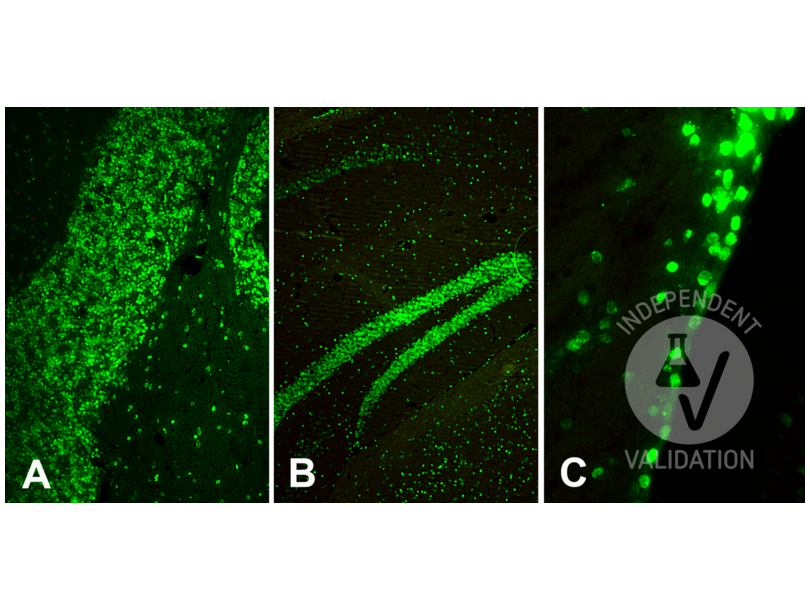
CD1 mouse brain fixed in 4% paraformaldehyde.
- Contrôle négative
Control slices were processed for each experimental procedure, omitting the primary antibody. In this case, overnight incubation was only performed using a diluent solution.
- Conclusion
- Anticorps primaire
- ABIN7260401
- Anticorps secondaire
- Alexa Fluor 488 goat anti-rabbit (Invitrogen by Thermo Fisher Scientific, A11034, lot # 2380031), Alexa Fluor 488 donkey anti-rabbit (Invitrogen by Thermo Fisher Scientific A32790 lot # XJ357262).
- Full Protocol
- SAMPLE ANALYZED: Old (> 18 months) CD1 mouse brain.
- Mice were perfused with paraformaldehyde 4% in 0.1M phosphate buffer (PB) pH 7.4 and samples were post-fixed in the same fixative for 2 additional hours at room temperature. After fixation, samples were washed, dehydrated, and embedded in paraffin wax.
- Following several washes in PBS, the brain was cut with a microtome (6 µm-thick sections) in parasagittal sections mounted on glass slides.
- After paraffin removal, sections were incubated for 1 hour at room temperature in PBS containing 1% albumin from chicken egg white (Sigma, A5378) and 0.3% Triton-X-100 (BioRad, 161-0407, lot # 00583) to block non-specific binding sites. Sections were then incubated overnight at room temperature with the primary antibody anti- Histone H4 (3meLys20) (ABIN7260401) at 1:50, 1:100, and 1:200, in PBS-BSA (Sigma, A7906)-PLL (Sigma, P1524).
- Antigen retrieval treatment was also tested. In this case, sections were processed for microwave antigen retrieval for 10 minutes (95-100° C) in 10 mM sodium citrate buffer (pH 6.0). After 20 minutes of spontaneous cooling, sections were washed (distilled water, 2 times for 5 min each; followed by PBS for 5 min).
- Sections were washed 3x5 min in 0.01M PBS.
- Sections were then incubated with the anti-rabbit secondary antibody Alexa Fluor 488, 1:500, in 0.1M PBS, for 1 hour at room temperature.
- Sections were washed 3x5 min in 0.01M PBS.
- Specimens were mounted in Fluoroshield (Sigma, F6182, lot # MKCB0153V)
- Images were acquired with a Leica DM 6000B fluorescence microscope with a digital camera at 20 or 40x magnification.
- Notes
Passed. The antibody works for IHC-P at 1:100 and 1:200 concentrations with or without microwave antigen retrieval. Microwave treatment increases the intensity of staining.
Validation #104614 (Immunohistochemistry)
 Validation Images
![Histone H4 (3meLys20) positive nuclei in the mouse brain. A: Immunoreactive nuclei in the granular layer of the cerebral cortex (original magnification 20x). There are several positive nuclei also in the white matter. Microwave antigen retrieval. B: Immunoreactive nuclei in the hippocampus. Note the intense staining of the CA neurons (original magnification 20x). Microwave antigen retrieval. C: Immunoreactive nuclei in the subventricular zone of the lateral ventriculus (original magnification 63x). Microwave antigen retrieval. Primary antibody dilution: 1:100.]() Histone H4 (3meLys20) positive nuclei in the mouse brain. A: Immunoreactive nuclei in the granular layer of the cerebral cortex (original magnification 20x). There are several positive nuclei also in the white matter. Microwave antigen retrieval. B: Immunoreactive nuclei in the hippocampus. Note the intense staining of the CA neurons (original magnification 20x). Microwave antigen retrieval. C: Immunoreactive nuclei in the subventricular zone of the lateral ventriculus (original magnification 63x). Microwave antigen retrieval. Primary antibody dilution: 1:100.
Protocole
Histone H4 (3meLys20) positive nuclei in the mouse brain. A: Immunoreactive nuclei in the granular layer of the cerebral cortex (original magnification 20x). There are several positive nuclei also in the white matter. Microwave antigen retrieval. B: Immunoreactive nuclei in the hippocampus. Note the intense staining of the CA neurons (original magnification 20x). Microwave antigen retrieval. C: Immunoreactive nuclei in the subventricular zone of the lateral ventriculus (original magnification 63x). Microwave antigen retrieval. Primary antibody dilution: 1:100.
Protocole -
-
Format
- Liquid
-
Concentration
- 1 mg/mL
-
Buffer
- PBS with 0.02 % sodium azide, 50 % glycerol, pH 7.3
-
Agent conservateur
- Sodium azide
-
Précaution d'utilisation
- This product contains Sodium azide: a POISONOUS AND HAZARDOUS SUBSTANCE which should be handled by trained staff only.
-
Stock
- -20 °C
-
Stockage commentaire
- Store at -20°C. Avoid freeze / thaw cycles.
-
-
- Histone H4 (HISTH4)
-
Autre désignation
- Histone H4
-
Sujet
- Histones are basic nuclear proteins that are responsible for the nucleosome structure of the chromosomal fiber in eukaryotes. This structure consists of approximately 146 bp of DNA wrapped around a nucleosome, an octamer composed of pairs of each of the four core histones (H2A, H2B, H3, and H4). The chromatin fiber is further compacted through the interaction of a linker histone, H1, with the DNA between the nucleosomes to form higher order chromatin structures. This gene is intronless and encodes a replication-dependent histone that is a member of the histone H4 family. Transcripts from this gene lack polyA tails, instead, they contain a palindromic termination element. This gene is found in a histone cluster on chromosome 1. This gene is one of four histone genes in the cluster that are duplicated, this record represents the centromeric copy.
-
Poids moléculaire
-
Observed_MW: 11 kDa
Calculated_MW: 11 kDa
-
ID gène
- 8370
-
UniProt
- P62805
Antigène
-