HYAL1 anticorps (N-Term)
 (1 validation)
Aperçu rapide pour HYAL1 anticorps (N-Term) (ABIN2784343)
Antigène
Voir toutes HYAL1 AnticorpsReactivité
Hôte
Clonalité
Conjugué
Application
-
-
Épitope
- N-Term
-
Séquence
- TIFYSSQLGT YPYYTPTGEP VFGGLPQNAS LIAHLARTFQ DILAAIPAPD
-
Homologie
- Cow: 86%, Dog: 85%, Guinea Pig: 86%, Horse: 93%, Human: 100%, Mouse: 92%, Rabbit: 93%, Rat: 92%
-
Attributs du produit
- This is a rabbit polyclonal antibody against HYAL1. It was validated on Western Blot using a cell lysate as a positive control.
-
Purification
- Affinity Purified
-
Immunogène
- The immunogen is a synthetic peptide directed towards the N terminal region of human HYAL1
-
-
anti-Hyaluronidase-1 (HYAL1) (N-Term) antibody
HYAL1 Reactivité: Humain, Souris, Rat, Boeuf (Vache), Chien, Cobaye, Cheval, Lapin WB, IHC Hôte: Lapin Polyclonal unconjugated
anti-Hyaluronidase-1 (HYAL1) antibodyHYAL1 Reactivité: Humain, Souris, Rat WB, IHC Hôte: Lapin Polyclonal unconjugated
anti-Hyaluronidase-1 (HYAL1) (Internal Region) antibodyVerified HYAL1 Reactivité: Humain IHC, ELISA, IF, FACS Hôte: Chèvre Polyclonal unconjugated
anti-Hyaluronidase-1 (HYAL1) (AA 32-47), (N-Term) antibodyHYAL1 Reactivité: Humain, Souris, Rat, Singe WB, IHC, ICC Hôte: Lapin Polyclonal unconjugated
anti-Hyaluronidase-1 (HYAL1) (AA 136-435) antibodyHYAL1 Reactivité: Humain WB, IHC, ELISA Hôte: Lapin Polyclonal unconjugated
anti-Hyaluronidase-1 (HYAL1) (AA 1-253) antibodyHYAL1 Reactivité: Humain WB Hôte: Souris Polyclonal unconjugated
anti-Hyaluronidase-1 (HYAL1) (AA 136-435) antibodyHYAL1 Reactivité: Humain IHC, ELISA Hôte: Lapin Polyclonal unconjugated
anti-Hyaluronidase-1 (HYAL1) (AA 271-400) antibodyHYAL1 Reactivité: Humain ELISA, IF (cc), IF (p), IHC (p), IHC (fro) Hôte: Lapin Polyclonal unconjugated
anti-Hyaluronidase-1 (HYAL1) (AA 60-159) antibodyHYAL1 Reactivité: Humain WB, ELISA Hôte: Souris Polyclonal unconjugated
anti-Hyaluronidase-1 (HYAL1) (AA 60-159) antibodyHYAL1 Reactivité: Humain ELISA, IP Hôte: Souris Monoclonal 2H7 unconjugated
-
-
Indications d'application
- Optimal working dilutions should be determined experimentally by the investigator.
-
Commentaires
-
Antigen size: 435 AA
-
Restrictions
- For Research Use only
-
-
- by
- University of Manitoba, Max Rady College of Medicine Biochemistry and Medical Genetics, Department of Biochemistry and Medical Genetics
- No.
- #100034
- Date
- 16.08.2016
- Antigène
- HYAL1 antibody - N-terminal region
- Numéro du lot
- QC23783
- Application validée
- Immunohistochemistry
- Contrôle positif
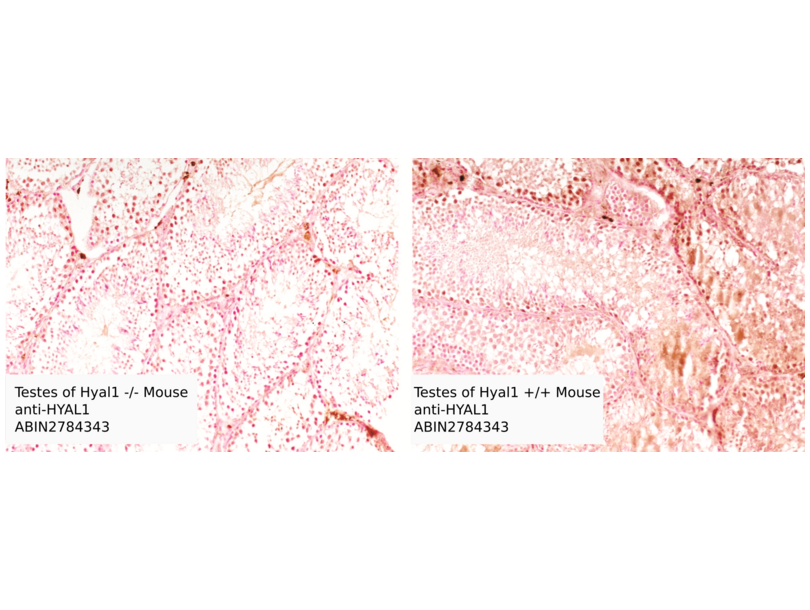
- Testes of Hyal1 +/+ mouse
- Contrôle négative
- Testes of Hyal1 -/- mouse
- Conclusion
- ABIN2784343 does detect mouse HYAL1 by immunohistochemistry in paraffin sections. The immunohistochemistry is based on increased signal in wild type mouse testes compared to Hyal1-/- mouse testes.
- Anticorps primaire
- ABIN2784343
- Anticorps secondaire
- Goat-anti-rabbit AF568
- Full Protocol
- Deparafinize and rehydrate:
- xylene (I & II) – 2x 5min
- 100% Ethanol (I & II) – 2x 5min
- 95% Ethanol (I & II) – 2x 3min
- 70% Ethanol (I) – 3min
- 50% Ethanol (I) – 3min
- ddH2O – 3min
- Antigen retrieval:
- Immerse slides in citrate buffer (10mM Sodium citrate at pH6.0) preheated to 95°C.
- Incubate at 95°C for 20min.
- Cool down at RT for 20min.
- Wash twice with PBS for 5min.
- Immunostaining:
- Block in blocking solution (prepare 3% BSA in TBST) at RT for 60min.
- Incubate sections with primary Hyaluronidase-1 (HYAL1) (N-Term) antibody ABIN2784343 diluted 1:200 in blocking solution.
- Incubate at 4°C overnight.
- Wash slides three times with TBST 5min.
- Incubate sections with goat-anti-rabbit AF568 secondary antibody conjugate diluted 1:500 in blocking solution.
- Incubate at RT for 1h.
- Wash slides in TBST - 1x 5min at RT.
- Wash three times with H2O for 5min.
- Incubated in Hoechst solution diluted 1:100.000 for 8-9min.
- Wash twice with H2O for 5min.
- Mounted with ProLong Gold (ThermoFisher, P36931) solution.
- Notes
Validation #100034 (Immunohistochemistry)
 Validation Images
![Testes of Hyal1 -/- mouse (A) or Hyal1 +/+ mouse (B) stained with ABIN2784342 as described in the protocol.]() Testes of Hyal1 -/- mouse (A) or Hyal1 +/+ mouse (B) stained with ABIN2784342 as described in the protocol.
Protocole
Testes of Hyal1 -/- mouse (A) or Hyal1 +/+ mouse (B) stained with ABIN2784342 as described in the protocol.
Protocole -
-
Format
- Liquid
-
Concentration
- Lot specific
-
Buffer
- Liquid. Purified antibody supplied in 1x PBS buffer with 0.09 % (w/v) sodium azide and 2 % sucrose.
-
Agent conservateur
- Sodium azide
-
Précaution d'utilisation
- This product contains Sodium azide: a POISONOUS AND HAZARDOUS SUBSTANCE which should be handled by trained staff only.
-
Conseil sur la manipulation
- Avoid repeated freeze-thaw cycles.
-
Stock
- -20 °C
-
Stockage commentaire
- For short term use, store at 2-8°C up to 1 week. For long term storage, store at -20°C in small aliquots to prevent freeze-thaw cycles.
-
-
- HYAL1 (Hyaluronidase-1 (HYAL1))
-
Autre désignation
- HYAL1
-
Sujet
-
HYAL1 is a lysosomal hyaluronidase. Hyaluronidases intracellularly degrade hyaluronan, one of the major glycosaminoglycans of the extracellular matrix. Hyaluronan is thought to be involved in cell proliferation, migration and differentiation. This enzyme is active at an acidic pH and is the major hyaluronidase in plasma. Mutations in this gene are associated with mucopolysaccharidosis type IX, or hyaluronidase deficiency. This gene is one of several related genes in a region of chromosome 3p21.3 associated with tumor suppression. Multiple transcript variants encoding different isoforms have been found for this gene.This gene encodes a lysosomal hyaluronidase. Hyaluronidases intracellularly degrade hyaluronan, one of the major glycosaminoglycans of the extracellular matrix. Hyaluronan is thought to be involved in cell proliferation, migration and differentiation. This enzyme is active at an acidic pH and is the major hyaluronidase in plasma. Mutations in this gene are associated with mucopolysaccharidosis type IX, or hyaluronidase deficiency. The gene is one of several related genes in a region of chromosome 3p21.3 associated with tumor suppression. Multiple transcript variants encoding different isoforms have been found for this gene.
Alias Symbols: HYAL-1, LUCA1, MGC45987, NAT6
Protein Interaction Partner: UBC, COL2A1,
Protein Size: 435 -
Poids moléculaire
- 45 kDa
-
ID gène
- 3373
-
NCBI Accession
- NM_153282, NP_695014
-
UniProt
- Q12794
-
Pathways
- Glycosaminoglycan Metabolic Process
Antigène
-