STING/TMEM173 anticorps (C-Term)
 (1 validation)
Aperçu rapide pour STING/TMEM173 anticorps (C-Term) (ABIN3043423)
Antigène
Voir toutes STING/TMEM173 (TMEM173) AnticorpsReactivité
Hôte
Clonalité
Conjugué
Application
-
-
Épitope
- AA 284-316, C-Term
-
Fonction
- Anti-TMEM173 Antibody
-
Séquence
- RLEQAKLFCR TLEDILADAP ESQNNCRLIA YQE
-
Réactivité croisée (Details)
- No cross-reactivity with other proteins
-
Attributs du produit
- Anti-TM Antibody (ABIN3043423). Tested in IHC, WB applications. This antibody reacts with Human. This is a premium antibody that guarantees superior quality, high affinity, and strong signals with minimal background in Western blot applications.
-
Purification
- Immunogen affinity purified.
-
Immunogène
- A synthetic peptide corresponding to a sequence at the C-terminus of human TMEM173, different from the related mouse sequence by five amino acids.
-
Isotype
- IgG
-
-
anti-Transmembrane Protein 173 (TMEM173) (AA 170-379) antibody
TMEM173 Reactivité: Humain WB, IHC, IP, IF Hôte: Lapin Polyclonal unconjugated
anti-Transmembrane Protein 173 (TMEM173) (AA 159-373) antibodyTMEM173 Reactivité: Humain WB Hôte: Lapin Polyclonal unconjugated
anti-Transmembrane Protein 173 (TMEM173) antibodyTMEM173 Reactivité: Humain WB, IHC, IHC (p) Hôte: Souris Monoclonal 4H8 unconjugated
anti-Transmembrane Protein 173 (TMEM173) antibodyTMEM173 Reactivité: Souris WB, IHC Hôte: Lapin Polyclonal unconjugated
anti-Transmembrane Protein 173 (TMEM173) (AA 311-340) antibodyTMEM173 Reactivité: Humain WB, IHC, ELISA, FACS Hôte: Lapin Polyclonal unconjugated
anti-Transmembrane Protein 173 (TMEM173) (AA 207-379) antibodyTMEM173 Reactivité: Humain WB, IHC, ELISA, IF Hôte: Lapin Polyclonal unconjugated
anti-Transmembrane Protein 173 (TMEM173) (AA 311-340), (C-Term) antibodyTMEM173 Reactivité: Humain WB, FACS, IHC (p) Hôte: Lapin Polyclonal RB25470 unconjugated
anti-Transmembrane Protein 173 (TMEM173) (C-Term) antibodyTMEM173 Reactivité: Humain, Souris WB, ELISA, IHC (p) Hôte: Lapin Polyclonal unconjugated
anti-Transmembrane Protein 173 (TMEM173) (AA 311-340), (C-Term) antibodyTMEM173 Reactivité: Humain WB, FACS Hôte: Lapin Polyclonal RB24462 unconjugated
anti-Transmembrane Protein 173 (TMEM173) (C-Term) antibodyTMEM173 Reactivité: Humain, Souris WB, ELISA, IHC (p) Hôte: Lapin Polyclonal unconjugated
-
-
Indications d'application
-
Immunohistochemistry (Paraffin-embedded Section), 0.5-1 μg/mL, Human
Western blot, 0.1-0.5 μg/mL, Human
-
Commentaires
-
Antibody can be supported by chemiluminescence kit ABIN921124 in WB, supported by ABIN921231 in IHC(P).
-
Restrictions
- For Research Use only
-
-
- by
- University of California, Los Angeles
- No.
- #100035
- Date
- 02.07.2016
- Antigène
- Anti-TMEM173 Picoband™ Antibody
- Numéro du lot
- 0951512Da071365
- Application validée
- Immunohistochemistry
- Contrôle positif
- Human pancreatic adenocarcinoma (PDAC)
- Contrôle négative
- Conclusion
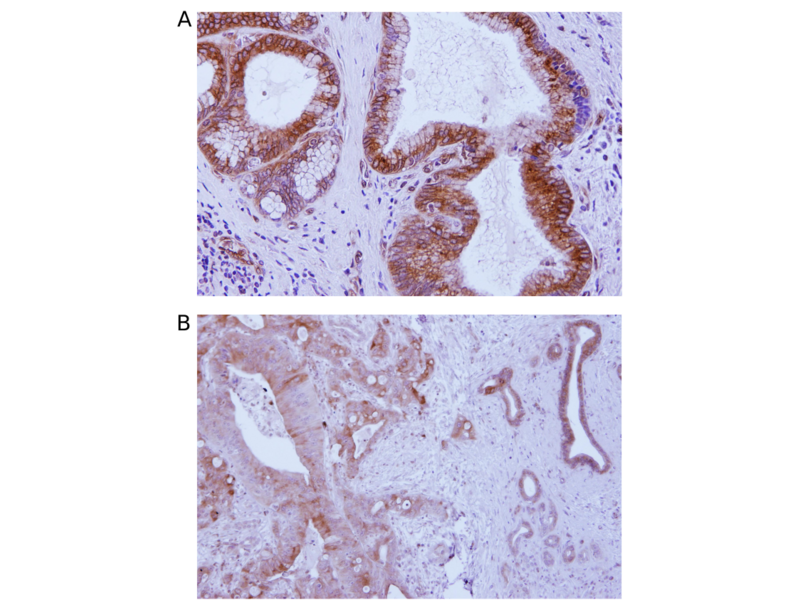
- In primary human pancreatic tumor tissue, ABIN3043423 stains specifically the tumor cell cytoplasm only, not fibroblasts.
- Anticorps primaire
- ABIN3043423
- Anticorps secondaire
- Biotin-SP-AffinPure Donkey-anti-rabbit IgG (H+L), Jackson ImmunoResearch, cat#711-065-152
- Full Protocol
- Deparaffinize slides
- Bake slides in oven at 60°C for 1h and let cool completely to RT.
- Rehydrate:
- Xylene 3x 5min
- 100% EtOH 2x 2min
- 95% EtOH 3x 2min
- 70% EtOH 1x 2min
- 50% EtOH 1x 2min
- H2O 2x 3min
- Blocking peroxidase activity
- Treat in 3% H2O2-PBS for 15min on rotator at RT (240 ml/slide hold chamber).
- Wash with PBS 3x 2min.
- Antigen retrieval
- Citrate buffer stock solution 100x, pH6.0 working solution 0.01M, freshly diluted into working solution.
- Boil Citrate buffer until 100°C on hot plate, put slides in the boiled buffer, keep boiling 15min, then let them cool down on bench top for 20min.
- Wash with H2O 2x 2min.
- Wash with PBS 3x 5min.
- PAP-pen cycles the slides: using vacuum to suck off the solution by cycling around the tissue area, then using the PAP-pen draw along the cycle line. Make sure the tissue area is kept wet.
- Apply blocking solution
- Incubate with 50-100µl (cover the whole tissue area) 5% donkey serum in PBS for 1h in moist a box at RT.
- Blocking stock solution: 5% donkey serum in 10 ml PBS.
- Drain blocking solution and blot excess liquid with Kim wipe.
- Prepare primary antibody solution in blocking buffer.
- Apply primary antibody
- Dilute primary TMEM173 antibody ABIN3043423 1:500 dilution in 5% normal goat serum in PBS.
- Incubate overnight in a box at 4°C to assure amoist environment and prevent slides from drying.
- Wash with 0.05% Tween-PBS3x 5min.
- Dilute Biotin-SP-AffinPure Donkey-anti-rabbit IgG (H+L) secondary antibody with 5% blocking solution (5% donkey serum)
- Incubate 1h with secondary antibody at room temperature.
- Prepare ABC solution 1:200: dilute both A and B in 0.05% Tween-PBS. Allow ABC diluted solution to sit for 30-60min before using, keep in the dark.
- Wash with 0.05% Tween-PBS 5min, 7min, and 7min.
- Apply 250µL/slide ABC solution; incubate for 30min at RT in moist incubation box.
- Wash with 0.05% Tween-PBS 5min, 7min, and 7min.
- Filter Hematoxylin.
- Prepare fresh DAB solution in disposable beaker (do not allow solution to sit):
- 2.5ml H2O + 1 drop buffer + 2 drops DAB + 1 drop H2O2
- Use transfer pipette to apply DAB x 1min
- Wash 3x with dH2O (10 dips each).
- Hematoxylin stain 5-10sec.
- Wash until water is clear.
- Hematoxylin stain 5-10sec.
- Dehydrate
- 50% EtOH 1x 2min.
- 70% EtOH 1x 2min.
- 95% EtOH 2x 2min.
- 100% EtOH 2x 2min.
- Xylene 3x 5min.
- Apply cover-slip. Allow glue to dry overnight.
- Notes
Validation #100035 (Immunohistochemistry)
 Validation Images
![Immunohistochemistry on pancreatic adenocarcinoma (PDAC) FFPE tissue sections. The primary TMEM173 antibody ABIN3043423 was used 1:500 diluted in 5% normal Goat serum in PBS with a biotin-donkey-anti-rabbit IgG (H+L) secondary antibody. A. IHC staining of PDAC tissue from patient #1 at 400x magnification. B. IHC staining of PDAC tissue from patient #2 at 200x magnification.]() Immunohistochemistry on pancreatic adenocarcinoma (PDAC) FFPE tissue sections. The primary TMEM173 antibody ABIN3043423 was used 1:500 diluted in 5% normal Goat serum in PBS with a biotin-donkey-anti-rabbit IgG (H+L) secondary antibody. A. IHC staining of PDAC tissue from patient #1 at 400x magnification. B. IHC staining of PDAC tissue from patient #2 at 200x magnification.
Protocole
Immunohistochemistry on pancreatic adenocarcinoma (PDAC) FFPE tissue sections. The primary TMEM173 antibody ABIN3043423 was used 1:500 diluted in 5% normal Goat serum in PBS with a biotin-donkey-anti-rabbit IgG (H+L) secondary antibody. A. IHC staining of PDAC tissue from patient #1 at 400x magnification. B. IHC staining of PDAC tissue from patient #2 at 200x magnification.
Protocole -
-
Format
- Lyophilized
-
Reconstitution
- Add 0.2 mL of distilled water will yield a concentration of 500 μg/mL.
-
Concentration
- 500 μg/mL
-
Buffer
- Each vial contains 5 mg BSA, 0.9 mg NaCl, 0.2 mg Na2HPO4, 0.05 mg Sodium azide.
-
Agent conservateur
- Sodium azide
-
Précaution d'utilisation
- This product contains Sodium azide: a POISONOUS AND HAZARDOUS SUBSTANCE which should be handled by trained staff only.
-
Conseil sur la manipulation
- Avoid repeated freezing and thawing.
-
Stock
- 4 °C,-20 °C
-
Stockage commentaire
-
Store at -20°C for one year from date of receipt. After reconstitution, at 4°C for one month.
It can also be aliquotted and stored frozen at -20°C for six months. Avoid repeated freeze-thaw cycles.
-
-
- STING/TMEM173 (TMEM173) (Transmembrane Protein 173 (TMEM173))
-
Autre désignation
- TMEM173
-
Sujet
-
Synonyms: Stimulator of interferon genes protein,hSTING,Endoplasmic reticulum interferon stimulator,ERIS,Mediator of IRF3 activation,hMITA,Transmembrane protein 173,TMEM173,ERIS, MITA, STING,
Tissue Specificity: Ubiquitously expressed. Expressed in skin endothelial cells, alveolar type 2 pneumocytes, bronchial epithelium and alveolar macrophages. .
Background: Transmembrane protein 173 is a protein that in humans is encoded by the TMEM173 gene. This gene encodes a five transmembrane protein that functions as a major regulator of the innate immune response to viral and bacterial infections. The encoded protein is a pattern recognition receptor that detects cytosolic nucleic acids and transmits signals that activate type I interferon responses. Also the encoded protein has been shown to play a role in apoptotic signaling by associating with type II major histocompatibility complex. Mutations in this gene are the cause of infantile-onset STING-associated vasculopathy. Alternate splicing results in multiple transcript variants.
Sequence Similarities: Belongs to the transcription factor STAT family.
-
Poids moléculaire
- 42 kDa
-
ID gène
- 340061
-
Pathways
- Activation of Innate immune Response
Antigène
-