
KLH anticorps
L’anticorps anti-KLH Polyclonal Lapin est utilisé pour la détection de KLH dans des échantillons de Keyhole Limpet. Il a été validé pour WB, IHC (fro) et EIA. L’anticorps a en outre été validé indépendamment.
2 images
 (1 validation)
N° du produit ABIN401183
1.467,69 €
Plus frais de livraison 40,00 € et TVA
1 mg
Destination:
France
Envoi sous 17 jours ouvrables
Aperçu rapide pour KLH anticorps (ABIN401183)
Antigène
Voir toutes KLH Anticorps
KLH
(Keyhole Limpet Hemocyanin (KLH))
Reactivité
Keyhole Limpet
Hôte
Lapin
Clonalité
Polyclonal
Conjugué
Cet anticorp KLH est non-conjugé
Application
Western Blotting (WB), Immunohistochemistry (Frozen Sections) (IHC (fro)), Enzyme Immunoassay (EIA)
-
-
Purification
- Immunoaffinity Chromatography using KLH coupled to agarose beads followed by solid phase adsorption(s) to remove any unwanted reactivities.
-
Immunogène
- KLH (Keyhole Limpet Hemocyanin)
-
Isotype
- IgG
-
-
anti-Keyhole Limpet Hemocyanin (KLH) antibody
KLH Reactivité: Keyhole Limpet ELISA, WB Hôte: Lapin Polyclonal unconjugated
anti-Keyhole Limpet Hemocyanin (KLH) antibodyKLH Reactivité: Keyhole Limpet ELISA, WB, IL Hôte: Lapin Polyclonal unconjugated
-
-
Indications d'application
-
ELISA: 1/400000. Western Blot: 1/40000. Immunohistochemistry: 1/20000.
Other applications not tested.
Optimal dilutions are dependent on conditions and should be determined by the user. -
Restrictions
- For Research Use only
-
-
- by
- Department of Pathology and Molecular Medicine, McMaster University
- No.
- #101355
- Date
- 01.06.2017
- Antigène
- KLH
- Numéro du lot
- 30477
- Application validée
- Immunohistochemistry
- Contrôle positif
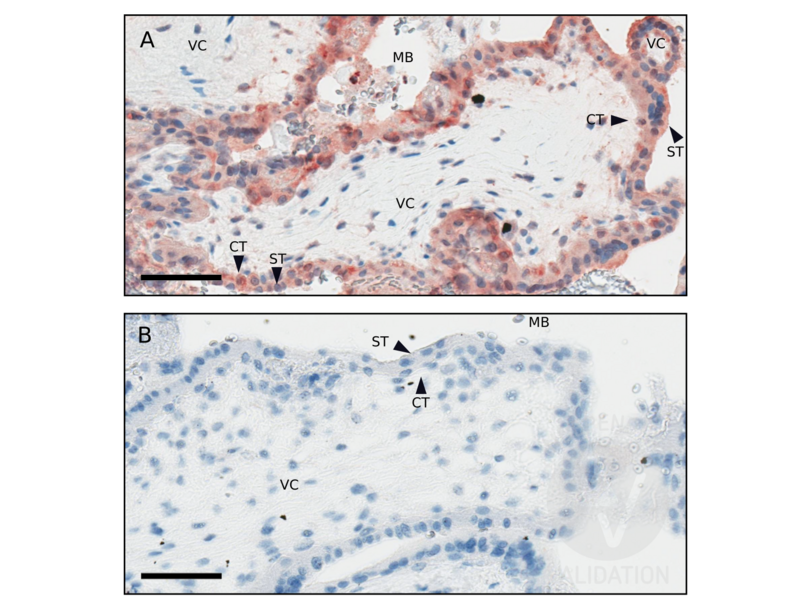
- Placental villus from 7w gestation karyotype-normal pregnancy, stained with CD200R1L antibody ABIN1715098
- Contrôle négative
- Placental villus from 7w gestation karyotype-normal pregnancy, stained with KLH antibody ABIN401183
- Conclusion
- Passed. ABIN401183 does not unspecifically stain human placental villus trophoblast tissue in IHC.
- Anticorps primaire
- ABIN401183
- Anticorps secondaire
- Dako EnVision-HRP anti-rabbit polymer (Dako, K4003, lot 10095566)
- Full Protocol
- Human placental tissue is fixed in 10% buffered formalin for 24h at RT and embedded in paraffin.
- Cut paraffin blocks with a Leica 12M2255 Microtome into 4µm sections.
- Affix sections to positively charged slides and air dry.
- Deparaffinize and rehydrate sections through graded xylene and graded alcohol series:
- xylene 3x 5 min.
- 100% ethanol 3x 1min.
- 95% ethanol for 1min.
- 70% ethanol for 1min.
- dH2O for 2min.
- Heat the sections in the decloaking Digital Decloaking chamber (Biacore, DC-2002) using factory settings (125°C for 30sec and cool) in 1mM EDTA buffer pH8.0 (0.37g EDTA (disodium salt) in 1l dH2O, adjust to pH8.0 using 1 M NaOH, add 1 small crystal thymol).
- Rinse sections 3 times with 0.05 M Tris-buffered saline pH 7.6 with 0.1% Tween 20 (TBST) 3x for 5min.
- Block sections in 5% normal goat serum (Jackson Immuno Research, 005-000-121, lot 116831) in TBST fo 30min at RT.
- Blot excess serum from sections.
- Incubate sections with
- primary rabbit anti-CD200 Receptor 1-Like (CD200R1L) (AA 150-200) antibody(antibodies-online, ABIN1715098, lot 9A13M60) diluted 1:250 in antibody diluent (Thermo Fisher TA-125-ADQ Lot ADQ 151111) ON at 4°C.
- primary rabbit anti-KLH antibody also antigen-affinity purified (antibodies-online, ABIN401183, lot 30477) diluted 1:250 in Antibody Diluent (as above) ON at 4°C.
- Rinse sections 3x 5min with TBST.
- Stain sections with Dako EnVision-HRP anti-rabbit polymer (Dako, K4003, lot 10095566) for 30min at RT.
- Rinse sections 3x 5min with TBST.
- Stain 30min with AEC (5 ml AEC stock (80mg AEC in 20ml Dimethylformamide), 95 ml 0.05M acetate buffer pH 5.0, filter and add 2 drops of 30% hydrogen peroxide to activate).
- Rinse with pH5.0 acetate buffer.
- Counterstain 1min with 50% Mayer’s hematoxylin.
- Wash in tap water and blue 1min in TBST.
- Mount sections in 15% glycerine/gelatin in TBST pH 8.0 and apply coverslip. Glycerine solution is made with 50 g gelatin (100 bloom) in 150ml TBS pH 8.0, incubated in a 60°C oven until the gelatin is melted, the 175 ml glycerine and a small pellet of thymol is added.
- Allow sections to dry.
- Scan slides using Imagescope and photograph at 400x. Quantification using Image J 1.4.
- Notes
Validation #101355 (Immunohistochemistry)
 Validation Images
![Representative villus from a 7 week gestation normal pregnancy with “normal karyotype” as determined by PCR testing to exclude trisomy, and digitally photographed at 400x. Staining with CD200R1L antibody ABIN1715098 (A) or KLH antibody ABIN401183 (B). VC: villus core, CT: cytotrophoblast, ST: syncytiotrophoblast, MB: maternal blood space bathing placental villi. Note more intense staining of cytotrophoblasts compared to syncytiotrophoblasts. Bars represent 60µm.]() Representative villus from a 7 week gestation normal pregnancy with “normal karyotype” as determined by PCR testing to exclude trisomy, and digitally photographed at 400x. Staining with CD200R1L antibody ABIN1715098 (A) or KLH antibody ABIN401183 (B). VC: villus core, CT: cytotrophoblast, ST: syncytiotrophoblast, MB: maternal blood space bathing placental villi. Note more intense staining of cytotrophoblasts compared to syncytiotrophoblasts. Bars represent 60µm.
Protocole
Representative villus from a 7 week gestation normal pregnancy with “normal karyotype” as determined by PCR testing to exclude trisomy, and digitally photographed at 400x. Staining with CD200R1L antibody ABIN1715098 (A) or KLH antibody ABIN401183 (B). VC: villus core, CT: cytotrophoblast, ST: syncytiotrophoblast, MB: maternal blood space bathing placental villi. Note more intense staining of cytotrophoblasts compared to syncytiotrophoblasts. Bars represent 60µm.
Protocole -
-
Concentration
- 1.0 mg/mL (by UV absorbance at 280 nm)
-
Buffer
- 0.02 M Potassium Phosphate, 0.12 M Sodium Chloride, pH 7.2 containing 0.01 % (w/v) Sodium Azide
-
Agent conservateur
- Sodium azide
-
Précaution d'utilisation
- This product contains sodium azide: a POISONOUS AND HAZARDOUS SUBSTANCE which should be handled by trained staff only.
-
Conseil sur la manipulation
- Avoid repeated freezing and thawing.
-
Stock
- 4 °C/-20 °C
-
Stockage commentaire
- Store the antibody undiluted at 2-8 °C for one month or (in aliquots) at-20 °C for longer.
-
-
- KLH (Keyhole Limpet Hemocyanin (KLH))
-
Sujet
- KLH (Keyhole Limpet Hemocyanin) is a copper containing oxygen carrier occurring freely dissolved in the hemolymph of many molluscs and arthropods. KLH is often used in molecular immunology as a carrier protein conjugated to low molecular weight molecules such as peptides, amino acids, nucleic acids, drugs or toxins to render them more immunogenic due to the size of the conjugate complex and the immunogenicity of KLH. KLH forms a large complex composed of ~50 kDa subunits.Synonyms: Keyhole Limpet Hemocyanine
Antigène
-

Vous êtes ici:


