Caspase 3 p17 (Cleaved-Asp175) anticorps
 (1 validation)
Aperçu rapide pour Caspase 3 p17 (Cleaved-Asp175) anticorps (ABIN7251013)
Antigène
Reactivité
Hôte
Clonalité
Conjugué
Application
-
-
Épitope
- Cleaved-Asp175
-
Attributs du produit
- Polyclonal Antibody
-
Purification
- Affinity purification
-
Immunogène
- Synthesized peptide derived from the Internal region of human Caspase-3 p17
-
Isotype
- IgG
-
-
anti-Caspase 3 p17 (AA 100-180), (Cleaved-Asp175) antibody
Reactivité: Humain, Souris, Rat WB, IF, ELISA, IHC (p) Hôte: Lapin Polyclonal unconjugated
anti-Caspase 3 p17 (Asp175), (cleaved) antibodyReactivité: Humain, Souris, Rat WB, IF, IHC (pfa) Hôte: Lapin Polyclonal unconjugated
anti-Caspase 3 p17 (Center) antibodyReactivité: Humain, Souris, Rat, Boeuf (Vache), Singe, Mouton WB, IF, IHC, IC Hôte: Lapin Polyclonal unconjugated
anti-Caspase 3 p17 (Center) antibodyReactivité: Humain, Souris, Rat, Boeuf (Vache), Chien, Porc WB Hôte: Lapin Polyclonal unconjugated
-
-
Indications d'application
- WB 1:500-2000, IHC 1:50-300, IF 1:50-300
-
Restrictions
- For Research Use only
-
-
- by
- Prof. Merighi, Laboratory of Neurobiology, Department of Veterinary Sciences, University of Turin
- No.
- #104629
- Date
- 15.03.2025
- Antigène
- Caspase 3 p17
- Numéro du lot
- DX03VBDV9989
- Application validée
- Immunohistochemistry
- Contrôle positif
The expression of caspase 3 at P5 was already attested in our laboratory (Lossi et al., 2004).
- Contrôle négative
A control slice was processed for each experimental procedure, omitting the primary antibody.
- Conclusion
- Reference: Lossi L., Tamagno I. and Merighi A. (2004) “Molecular morphology of neuronal apoptosis: analysis of Caspase 3 activation during postnatal development of mouse cerebellar cortex.” J Mol Histol, 35(6):621-9.
- Anticorps primaire
- ABIN7251013
- Anticorps secondaire
- anti-rabbit Alexa Fluor 488 (Invitrogen. Lot 2541675)
- Full Protocol
- Sample analyzed: mouse cerebellum at post-natal day (P) 5–6.
- Paraffin-embedded slices (7 µm thick) were deparaffinized and rehydrated through a graded series of alcohols and distilled water (dH2O).
- Sections were blocked in ovalbumin 1% 1 hour at room temperature.
- Antigen retrieval was performed in all the sections by microwave treatment (1 minute at 750 W + 1 minute at 250 W in citrate buffer pH 6).
- 3×5 minutes washing in 0.01 M PBS.
- Sections were incubated with the primary antibody at the following dilutions of 1:50/1:100/1:200, overnight at room temperature (primary antibody was diluted in PLL/BSA/PBS diluent).
- 3×5 minutes washing in 0.01 M PBS.
- Incubation with the anti-rabbit secondary antibody 1:400 in PLL/BSA/PBS diluent, 1 hour at room temperature.
- 3×5 minutes washing in 0.01 M PBS.
- Nuclear counterstaining was performed with DAPI 1 µg/mL, 2 minutes.
- 2×5 minutes washing in 0.01 M PBS.
- Specimens were then mounted in Fluoroshield mounting medium (Sigma).
- Notes
Passed. The antibody works in IHC-P at concentrations from 1:50-1:200
Validation #104629 (Immunohistochemistry)
 Validation Images
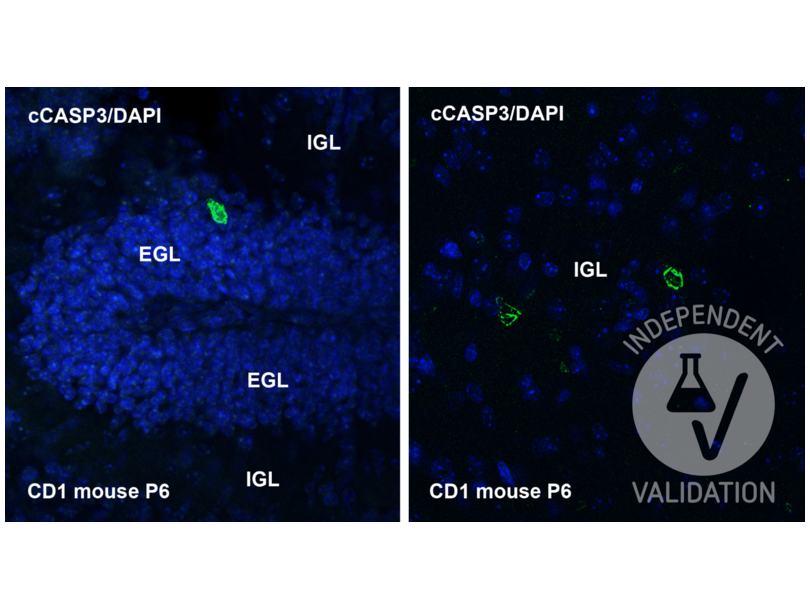
![Expression of cleaved caspase 3 (cCASP3) in P6 mouse cerebellum. An immunoreactive Purkinje neuron (left) and two cCASP3-positive granule cells (right) after immunostaining with ABIN7251013 and nuclear counterstaining with 4′,6-Diamidine-2′-phenylindole dihydrochloride (DAPI). EGL = external granular layer of the cerebellar cortex; IGL = internal granular layer of the cerebellar cortex.]() Expression of cleaved caspase 3 (cCASP3) in P6 mouse cerebellum. An immunoreactive Purkinje neuron (left) and two cCASP3-positive granule cells (right) after immunostaining with ABIN7251013 and nuclear counterstaining with 4′,6-Diamidine-2′-phenylindole dihydrochloride (DAPI). EGL = external granular layer of the cerebellar cortex; IGL = internal granular layer of the cerebellar cortex.
Protocole
Expression of cleaved caspase 3 (cCASP3) in P6 mouse cerebellum. An immunoreactive Purkinje neuron (left) and two cCASP3-positive granule cells (right) after immunostaining with ABIN7251013 and nuclear counterstaining with 4′,6-Diamidine-2′-phenylindole dihydrochloride (DAPI). EGL = external granular layer of the cerebellar cortex; IGL = internal granular layer of the cerebellar cortex.
Protocole -
-
Format
- Liquid
-
Concentration
- 1 mg/mL
-
Buffer
- PBS with 0.02 % sodium azide, 0.5 % BSA and 50 % glycerol, pH 7.4
-
Agent conservateur
- Sodium azide
-
Précaution d'utilisation
- This product contains Sodium azide: a POISONOUS AND HAZARDOUS SUBSTANCE which should be handled by trained staff only.
-
Stock
- -20 °C
-
Stockage commentaire
- Store at -20°C. Avoid freeze / thaw cycles.
-
-
- Caspase 3 p17
-
Autre désignation
- CASP3 p17
-
Sujet
- Involved in the activation cascade of caspases responsible for apoptosis execution. At the onset of apoptosis it proteolytically cleaves poly(ADP-ribose) polymerase (PARP) at a '216-Asp-Gly-217' bond. Cleaves and activates sterol regulatory element binding proteins (SREBPs) between the basic helix-loop-helix leucine zipper domain and the membrane attachment domain. Cleaves and activates caspase-6, -7 and -9. Involved in the cleavage of huntingtin.
-
Poids moléculaire
-
Observed_MW: 20 kDa
Calculated_MW: 32 kDa
-
UniProt
- P42574
Antigène
-