ORC1 anticorps
 (1 validation)
Aperçu rapide pour ORC1 anticorps (ABIN7252684)
Antigène
Voir toutes ORC1 (ORC1L) AnticorpsReactivité
Hôte
Clonalité
Conjugué
Application
-
-
Attributs du produit
- Polyclonal Antibody
-
Purification
- Antigen affinity purification
-
Immunogène
- Fusion protein of human ORC1
-
Isotype
- IgG
-
-
anti-Origin Recognition Complex, Subunit 1 (ORC1L) antibody
ORC1L Reactivité: Humain WB, IP Hôte: Rat Monoclonal 7A7 unconjugated
anti-Origin Recognition Complex, Subunit 1 (ORC1L) (AA 1-110) antibodyORC1L Reactivité: Humain ELISA, IHC (p) Hôte: Souris Monoclonal 3H1 unconjugated
anti-Origin Recognition Complex, Subunit 1 (ORC1L) antibodyORC1L Reactivité: Humain ELISA Hôte: Souris Monoclonal 7F6-1 unconjugated
anti-Origin Recognition Complex, Subunit 1 (ORC1L) (AA 696-856) antibodyORC1L Reactivité: Humain WB Hôte: Lapin Polyclonal unconjugated
anti-Origin Recognition Complex, Subunit 1 (ORC1L) (AA 170-220) antibodyORC1L Reactivité: Humain, Souris WB Hôte: Lapin Polyclonal unconjugated
anti-Origin Recognition Complex, Subunit 1 (ORC1L) (Internal Region) antibodyORC1L Reactivité: Humain WB, IF, ICC Hôte: Lapin Polyclonal unconjugated
anti-Origin Recognition Complex, Subunit 1 (ORC1L) (AA 1-110) antibodyORC1L Reactivité: Humain ELISA, WB Hôte: Souris Polyclonal unconjugated
-
-
Indications d'application
- IHC 1:50-1:300, ELISA 1:5000-1:10000
-
Restrictions
- For Research Use only
-
-
- by
- Prof. Merighi, Laboratory of Neurobiology, Department of Veterinary Sciences, University of Turin
- No.
- #104637
- Date
- 18.03.2026
- Antigène
- Origin Recognition Complex, Subunit 1 (ORC1)
- Numéro du lot
- DW04006249610
- Application validée
- Immunohistochemistry
- Contrôle positif
CD1 mouse brain fixed in 4% paraformaldehyde.
- Contrôle négative
Omission of primary/secondary antibody.
- Conclusion
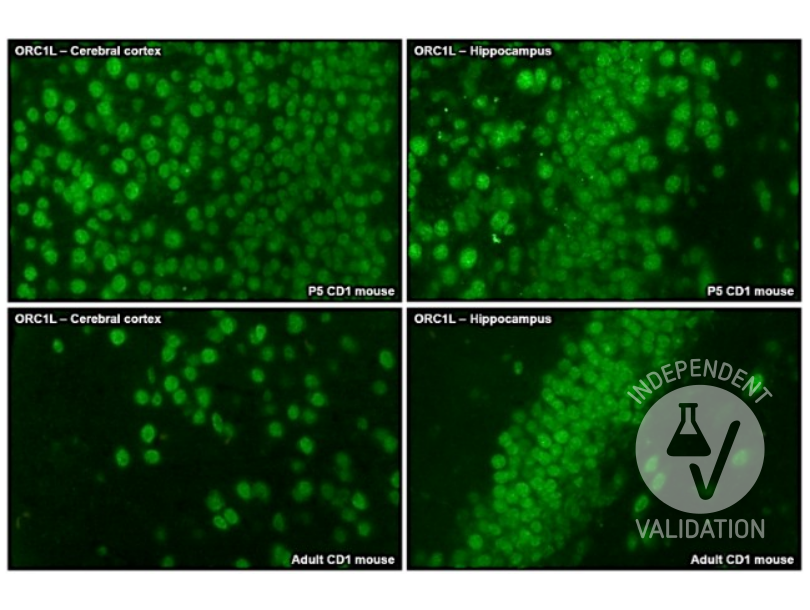
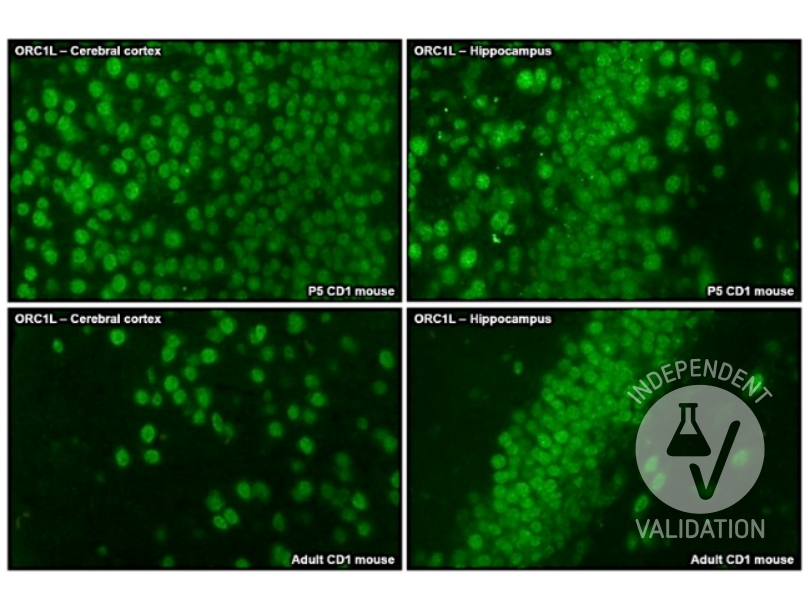
The antibody works in IHC-P and IHC (fro) at concentrations from 1:50-1:200. Microwave pretreatment is strongly suggested.
- Anticorps primaire
- ABIN7252683
- Anticorps secondaire
- anti-rabbit Alexa Fluor 488 (Invitrogen A11008, lot # 3112790)
- Full Protocol
- IHC (p)
- PROTOCOL
- Sample analyzed: P5 and adult (9 months old) CD1 mouse brain
- Paraffin-embedded slices (7µm thick) were deparaffinized and rehydrated through a graded series of alcohols and distilled water (dH2O)
- Sections were blocked in ovalbumin 1% 1 hour at room temperature
- Antigen retrieval was performed in all the sections by microwave treatment (1 minute at 750W + 1 minute at 250W in Citrate buffer pH 6)
- 3x5 minutes washing in 0.01M PBS
- Sections were incubated with the primary antibody at the following dilutions of 1:50/1:100/1:200, overnight at room temperature (primary antibody was diluted in PLL/BSA/PBS diluent)
- 3x5 minutes washing in 0.01M PBS
- Incubation with the anti-rabbit secondary antibody 1:400 in PLL/BSA/PBS diluent, 1 hour at room temperature.
- 3x5 minutes washing in 0.01M PBS
- Nuclear counterstaining was performed with 4′,6-Diamidine-2′-phenylindole dihydrochloride (DAPI) 1µg/mL, 2 minutes
- 2x5 minutes washing in 0.01M PBS
- Specimens were then mounted in Fluoroshield mounting medium (Sigma)
- Images were acquired with a Leica DM 6000B fluorescence microscope with a digital camera at 63x magnification
- PROTOCOL
- IHC (fro)
- PROTOCOL
- Sample analyzed: old (22 months old) CD1 mouse brain
- Samples were fixed in paraformaldehyde and cryoprotected with a series of sucrose solutions in 0.01M PBS at increasing concentrations (10%, 20%, 30%), then embedded with OCT compound in isopentane previously cooled in liquid nitrogen
- Frozen slices (10µm thick) were washed 3x5 minutes in 0.01M PBS
- Sections were blocked in ovalbumin 1% 1 hour at room temperature
- Antigen retrieval was performed in all the sections by microwave treatment (1 minute at 750W + 1 minute at 250W in Citrate buffer pH 6)
- 3x5 minutes washing in 0.01M PBS
- Sections were incubated with the primary antibody at the following dilutions of 1:50/1:100/1:200, overnight at room temperature (primary antibody was diluted in PLL/BSA/PBS diluent)
- 3x5 minutes washing in 0.01M PBS
- Incubation with the anti-rabbit secondary antibody 1:400 in PLL/BSA/PBS diluent, 1 hour at room temperature.
- 3x5 minutes washing in 0.01M PBS
- Nuclear counterstaining was performed with 4′,6-Diamidine-2′-phenylindole dihydrochloride (DAPI) 1µg/mL, 2 minutes
- 2x5 minutes washing in 0.01M PBS
- Specimens were then mounted in Fluoroshield mounting medium (Sigma)
- Slides were observed under a Leica DM 6000B fluorescence microscope
- PROTOCOL
- IHC (p)
- Notes
- For both IHC-P and IHC (fro) some slides were processed without microwave treatment to evaluate the actual necessity of antigen retrieval.
- To exclude any nonspecific signal due to the secondary antibody, one control slice was processed for each experimental procedure, omitting the primary antibody.
Validation #104637 (Immunohistochemistry)
 Validation Images
![Origin Recognition Complex, Subunit 1 (ORC1L) immunoreactive cells in the cerebral cortex and hippocampus of P5 and adult CD1 mice. IHC-P. Magnification: 63x.]() Origin Recognition Complex, Subunit 1 (ORC1L) immunoreactive cells in the cerebral cortex and hippocampus of P5 and adult CD1 mice. IHC-P. Magnification: 63x.
Protocole
Origin Recognition Complex, Subunit 1 (ORC1L) immunoreactive cells in the cerebral cortex and hippocampus of P5 and adult CD1 mice. IHC-P. Magnification: 63x.
Protocole -
-
Format
- Liquid
-
Concentration
- 1.14 mg/mL
-
Buffer
- PBS with 0.05 % Sodium azide and 40 % Glycerol, pH 7.4
-
Agent conservateur
- Sodium azide
-
Précaution d'utilisation
- This product contains Sodium azide: a POISONOUS AND HAZARDOUS SUBSTANCE which should be handled by trained staff only.
-
Stock
- -20 °C
-
Stockage commentaire
- Store at -20°C. Avoid freeze / thaw cycles.
-
-
- ORC1 (ORC1L) (Origin Recognition Complex, Subunit 1 (ORC1L))
-
Autre désignation
- ORC1
-
Sujet
- The origin recognition complex (ORC) is a highly conserved six subunits protein complex essential for the initiation of the DNA replication in eukaryotic cells. Studies in yeast demonstrated that ORC binds specifically to origins of replication and serves as a platform for the assembly of additional initiation factors such as Cdc6 and Mcm proteins. The protein encoded by this gene is the largest subunit of the ORC complex. While other ORC subunits are stable throughout the cell cycle, the levels of this protein vary during the cell cycle, which has been shown to be controlled by ubiquitin-mediated proteolysis after initiation of DNA replication. This protein is found to be selectively phosphorylated during mitosis. It is also reported to interact with MYST histone acetyltransferase 2 (MyST2/HBO1), a protein involved in control of transcription silencing. Alternatively spliced transcript variants encoding different isoforms have been found for this gene.ORC1 (Origin Recognition Complex Subunit 1) is a Protein Coding gene. Diseases associated with ORC1 include Meier-Gorlin Syndrome 1 and Microtia. Among its related pathways are E2F mediated regulation of DNA replication and CDK-mediated phosphorylation and removal of Cdc6. GO annotations related to this gene include chromatin binding. An important paralog of this gene is CDC6.
-
UniProt
- Q13415
-
Pathways
- Mitotic G1-G1/S Phases, DNA Replication, Synthesis of DNA
Antigène
-