Smad1/5 anticorps (AA 361-465)
 (2 références)
 (1 validation)
Aperçu rapide pour Smad1/5 anticorps (AA 361-465) (ABIN732158)
Antigène
Reactivité
Hôte
Clonalité
Conjugué
Application
-
-
Épitope
- AA 361-465
-
Réactivité croisée
- Humain
-
Homologie
- Mouse,Rat,Dog,Cow,Pig,Horse,Rabbit
-
Purification
- Purified by Protein A.
-
Immunogène
- KLH conjugated synthetic peptide derived from human Smad 5
-
Isotype
- IgG
-
-
anti-Smad1/5 Protein (SMAD1/5) (pSer463), (pSer465) antibody
SMAD1/5 Reactivité: Souris, Rat IF (cc), IF (p), WB, ELISA, IHC (fro), IHC (p), ICC Hôte: Lapin Polyclonal unconjugated
-
-
Indications d'application
-
ELISA 1:500-1000
FCM 1:20-100
IHC-P 1:200-400
IHC-F 1:100-500
IF(IHC-P) 1:50-200
IF(IHC-F) 1:50-200
IF(ICC) 1:50-200
ICC 1:100-500 -
Restrictions
- For Research Use only
-
-
- by
- Alamo Laboratories Inc
- No.
- #029752
- Date
- 03.07.2014
- Antigène
- Numéro du lot
- 120918
- Application validée
- Western Blotting
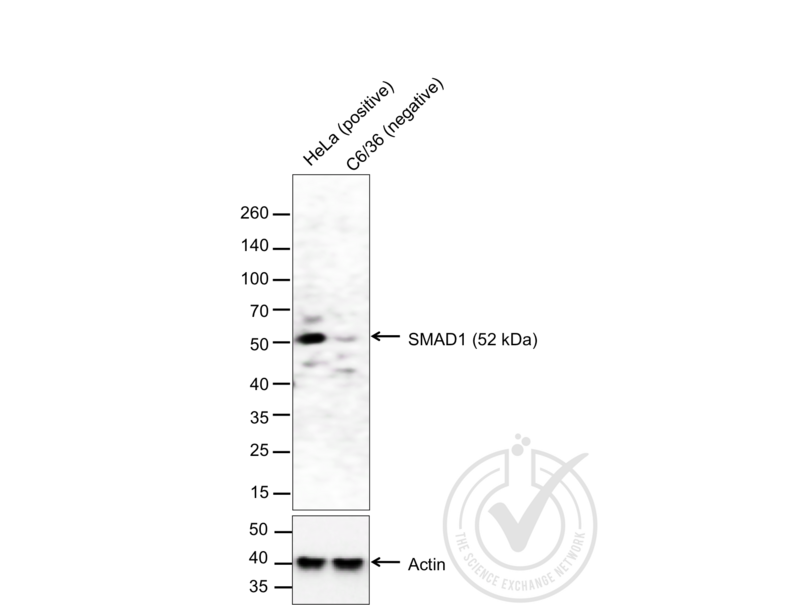
- Contrôle positif
- Hela cells
- Contrôle négative
- c6/36 cells (non-reactive species)
- Conclusion
- A single major band was observed in the positive control at the correct molecular weight. Several additional faint bands appeared in both the positive and negative controls, but they did not indicate significant non-specific interaction.
- Anticorps primaire
- Antigen: SMAD, Mothers Against DPP Homolog 1 (SMAD1) (1:200 dilution)
- Catalog number: ABIN732158
- Lot number: 120918
- Anticorps secondaire
- Antibody: Goat Anti-Rabbit IgG (H + L)-HRP Conjugate (1:20,000 dilution)
- Lot number: L170-6515
- Full Protocol
- 1. Total protein extracts were boiled in 1X SDS Sample Buffer containing 1% SDS and 1.25% β-mercaptoethanol at 95°C for 5 min prior to loading.
- 2. 58 μg of boiled extracts were loaded and resolved on 8-16% SDS-polyacrylamide gel.
- 3. The Thermo Scientific - Spectra Multicolor Broad Range (Cat # 26634) were used as molecular mass markers.
- 4. Proteins were then transferred onto PVDF membrane by wet transfer and protein transfer was confirmed with Ponceau-S staining.
- 5. The PVDF membrane was incubated with 25 mL of blocking buffer [Tris Buffered Saline, pH 7.4 plus 0.1% TW20 (TBST)] containing 5% (W/V) BSA at room temperature for 1 h.
- 6. The membrane was rinsed with TBST once.
- 7. The membrane was immersed with the protein side up in the primary antibody solution (anti-SMAD1; 1:200) in TBST containing 5% (W/V) BSA and incubated for 16 h at 4°C.
- 8. The membrane was rinsed in TBST thrice for 5 min each.
- 9. The membrane was incubated in the HRP-conjugated secondary antibody solution (Goat anti-rabbit IgG-HRP; 1:20,000) in TBST containing 5% (W/V) BSA and incubated for 1 h at room temperature (~26°C) with gentle agitation.
- 10. The membrane was rinsed in TBST thrice for 5 min each.
- 11. The membrane was rinsed in TBS twice for 30 s each.
- 12. Signals were detected with ECL-2 Substrate. The blot was scanned for 300 s.
- 13. The membrane was rinsed three times TBST.
- 14. Incubated in Acidic Glycine Stripping Buffer at room temperature with gentle agitation for 3 times, 10 min each.
- 15. The membrane was washed in TBST 2 times for 10 min each.
- 16. Repeated Steps 5-12 with the loading control antibody (anti-Actin; 1:6,000) and its matching secondary antibody (Goat anti-rabbit IgG-HRP; 1:20,000).
- Notes
- - No experimental challenges noted.
Validation #029752 (Western Blotting)
 Validation Images
![Figure 1. Western blot of lysates from HeLa cells (Lane 1) and c6/36 cells (Lane 2) probed with anti-SMAD1 (upper panel) or with anti-Actin for loading control (lower panel).]() Figure 1. Western blot of lysates from HeLa cells (Lane 1) and c6/36 cells (Lane 2) probed with anti-SMAD1 (upper panel) or with anti-Actin for loading control (lower panel).
Protocole
Figure 1. Western blot of lysates from HeLa cells (Lane 1) and c6/36 cells (Lane 2) probed with anti-SMAD1 (upper panel) or with anti-Actin for loading control (lower panel).
Protocole -
-
Format
- Liquid
-
Concentration
- 1 μg/μL
-
Buffer
- 0.01M TBS( pH 7.4) with 1 % BSA, 0.02 % Proclin300 and 50 % Glycerol.
-
Agent conservateur
- ProClin
-
Précaution d'utilisation
- This product contains ProClin: a POISONOUS AND HAZARDOUS SUBSTANCE, which should be handled by trained staff only.
-
Stock
- 4 °C,-20 °C
-
Stockage commentaire
- Shipped at 4°C. Store at -20°C for one year. Avoid repeated freeze/thaw cycles.
-
Date de péremption
- 12 months
-
-
-
: "MiR-199a-3p suppresses proliferation and invasion of prostate cancer cells by targeting Smad1." dans: Oncotarget, Vol. 8, Issue 32, pp. 52465-52473, (2017) (PubMed).
: "Smurf1 inhibits integrin activation by controlling Kindlin-2 ubiquitination and degradation." dans: The Journal of cell biology, Vol. 216, Issue 5, pp. 1455-1471, (2017) (PubMed).
-
: "MiR-199a-3p suppresses proliferation and invasion of prostate cancer cells by targeting Smad1." dans: Oncotarget, Vol. 8, Issue 32, pp. 52465-52473, (2017) (PubMed).
-
- Smad1/5 (SMAD1/5) (Smad1/5 Protein (SMAD1/5))
-
Autre désignation
- Smad1 + Smad5
-
Sujet
-
Synonyms: Mothers against decapentaplegic homolog 5, SMAD5, Mothers against decapentaplegic homolog 1, SMAD1
Background: Transcriptional modulator activated by BMP (bone morphogenetic proteins) type 1 receptor kinase. SMAD5 is a receptor-regulated SMAD (R-SMAD). Transcriptional modulator activated by BMP (bone morphogenetic proteins) type 1 receptor kinase. SMAD1 is a receptor-regulated SMAD (R-SMAD). SMAD1/OAZ1/PSMB4 complex mediates the degradation of the CREBBP/EP300 repressor SNIP1. May act synergistically with SMAD4 and YY1 in bone morphogenetic protein (BMP)-mediated cardiac-specific gene expression.
-
ID gène
- 4090, 4086
Antigène
-