APP anticorps
 (1 reference)
 (2 validations)
Aperçu rapide pour APP anticorps (ABIN95037)
Antigène
Voir toutes APP AnticorpsReactivité
Hôte
Clonalité
Conjugué
Application
-
-
N° du produit (Fournisseur)
- 600-401-253
-
Fournisseur
- Rockland
-
Fonction
- Beta Amyloid Antibody
-
Réactivité croisée (Details)
- This affinity purified antibody is directed against extracellular region of beta amyloid and is useful in determining its presence in various assays.
-
Attributs du produit
- Synonyms: rabbit anti-Beta Amyloid Antibody, ß-amyloid, Amyloid beta A4 protein, Alzheimer disease amyloid protein, Beta amyloid, A-beta, ABPP, APPI, Beta-amyloid precursor protein
-
Purification
- affinity purified antibody
-
Stérilité
- Sterile filtered
-
Immunogène
-
Immunogen: This antibody was affinity purified from whole rabbit serum prepared by repeated immunizations with a synthetic peptide corresponding to an extracellular region of human beta amyloid conjugated to KLH using maleimide.
Immunogen Type: Conjugated Peptide
-
Isotype
- IgG
-
-
anti-Amyloid beta (A4) Precursor Protein (APP) (C-Term) antibody
APP Reactivité: Humain WB, IF, ICC, IHC (p), IHC (fro) Hôte: Lapin Polyclonal unconjugated
anti-Amyloid beta (A4) Precursor Protein (APP) (AA 666-670) antibodyAPP Reactivité: Humain, Souris, Rat WB, IF Hôte: Lapin Polyclonal unconjugated
anti-Amyloid beta (A4) Precursor Protein (APP) (AA 18-270) antibodyAPP Reactivité: Humain WB, ELISA, IHC, IF Hôte: Lapin Polyclonal unconjugated
anti-Amyloid beta (A4) Precursor Protein (APP) (C-Term) antibodyAPP Reactivité: Humain, Souris, Rat WB, ELISA, IHC, IF, ICC Hôte: Lapin Polyclonal unconjugated
anti-Amyloid beta (A4) Precursor Protein (APP) (AA 381-480) antibodyAPP Reactivité: Humain, Souris, Rat WB, ELISA, ICC, IHC (p), IF (cc), IF (p), IHC (fro) Hôte: Lapin Polyclonal unconjugated
anti-Amyloid beta (A4) Precursor Protein (APP) (pThr668) antibodyAPP Reactivité: Humain, Souris, Rat WB, ELISA, IHC, IF, ICC Hôte: Lapin Polyclonal unconjugated
anti-Amyloid beta (A4) Precursor Protein (APP) antibodyKD Validated APP Reactivité: Humain WB, ICC, FACS Hôte: Lapin Monoclonal 23GB1535 unconjugated Recombinant Antibody
anti-Amyloid beta (A4) Precursor Protein (APP) antibodyAPP Reactivité: Humain WB, ELISA, IHC, IF, IP Hôte: Lapin Polyclonal unconjugated
anti-Amyloid beta (A4) Precursor Protein (APP) (C-Term) antibodyAPP Reactivité: Humain, Souris, Rat WB, IHC (p), FACS Hôte: Lapin Polyclonal unconjugated
anti-Amyloid beta (A4) Precursor Protein (APP) (AA 18-286) antibodyAPP Reactivité: Souris WB, IHC, ICC, IP Hôte: Lapin Polyclonal unconjugated
-
-
Indications d'application
-
Immunohistochemistry Dilution: 1:50-1:200
Application Note: Affinity purified anti-beta amyloid has been tested by ELISA, IHC, WB, and IF. A 45.8 kDa band is detected in western blot using whole tissue extracts and lysates from mouse and human. In general, we recommend the use of 4 % PFA or 10 % formalin for fixation of tissues with IHC-paraffin or IHC-frozen application of this antibody.
Western Blot Dilution: 1:1,000-1:5000
ELISA Dilution: 1:10,000 - 1:30,000
IF Microscopy Dilution: 1:50-1:200
Other: User Optimized
-
Restrictions
- For Research Use only
-
-
- by
- NanoTemper Technologies
- No.
- #104082
- Date
- 23.07.2019
- Antigène
- ABETA
- Numéro du lot
- Application validée
- Unfolding Profile
- Contrôle positif
- ABIN1043866
- Contrôle négative
- Conclusion
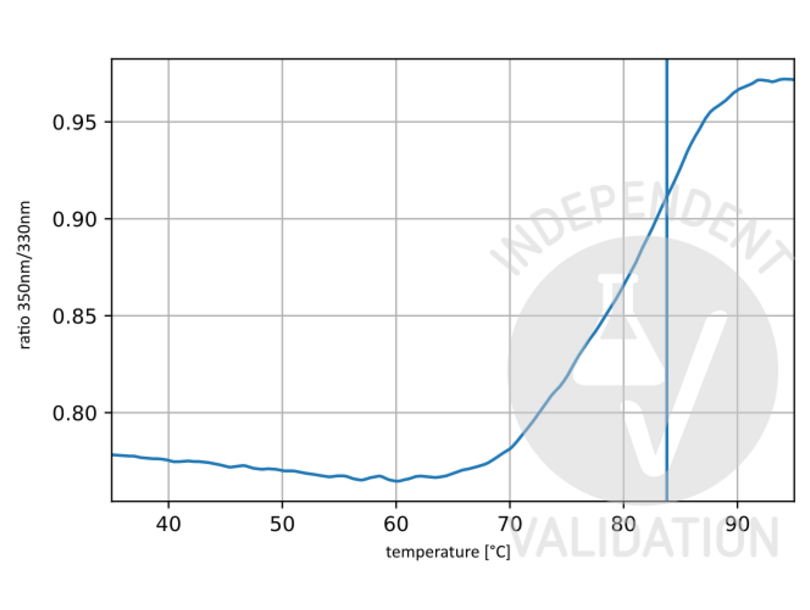
Passed. ABIN1043866 showed Ti at 83.8°C and a clear unfolding profile with one unfolding event. This suggests that the antibody is properly folded and functional.
- Anticorps primaire
- Anticorps secondaire
- Full Protocol
- Load the undiluted sample into Tycho capillary (NanoTemper Technologies, TY-C001).
- Run Tycho measurement.
- Notes
Tycho is designed to run quick and precise protein quality check experiments. Tycho uses intrinsic protein fluorescence to follow protein unfolding while running a fast thermal ramp, yielding results in 3min. A protein’s unfolding behavior is characterized by various parameters, most notably the inflection temperature (Ti). The Ti can be used to identify properly folded protein, to compare different batches, or to analyze the influence of storage/transport conditions on a protein. An absence of Ti would suggest that the protein is already unfolded and therefore most likely nonfunctional.
Validation #104082 (Unfolding Profile)
 Validation Images
![Unfolding profile of ABIN1043866. The fluorescence signal is plotted against temperature. The vertical line indicates the Ti at 83.8 °C.]() Unfolding profile of ABIN1043866. The fluorescence signal is plotted against temperature. The vertical line indicates the Ti at 83.8 °C.
Protocole
Unfolding profile of ABIN1043866. The fluorescence signal is plotted against temperature. The vertical line indicates the Ti at 83.8 °C.
Protocole -
- by
- Prof. Merighi, Laboratory of Neurobiology, Department of Veterinary Sciences, University of Turin
- No.
- #104424
- Date
- 12.05.2022
- Antigène
- beta Amyloid
- Numéro du lot
- 42581
- Application validée
- Immunohistochemistry
- Contrôle positif
Adult (24 months) mouse brain
3-month-old Taconic mouse Model 1349 brain fixed in 4% paraformaldehyde
- Contrôle négative
We incubated slices overnight with the blocking solution only and then processed them with the secondary antibody.
- Conclusion
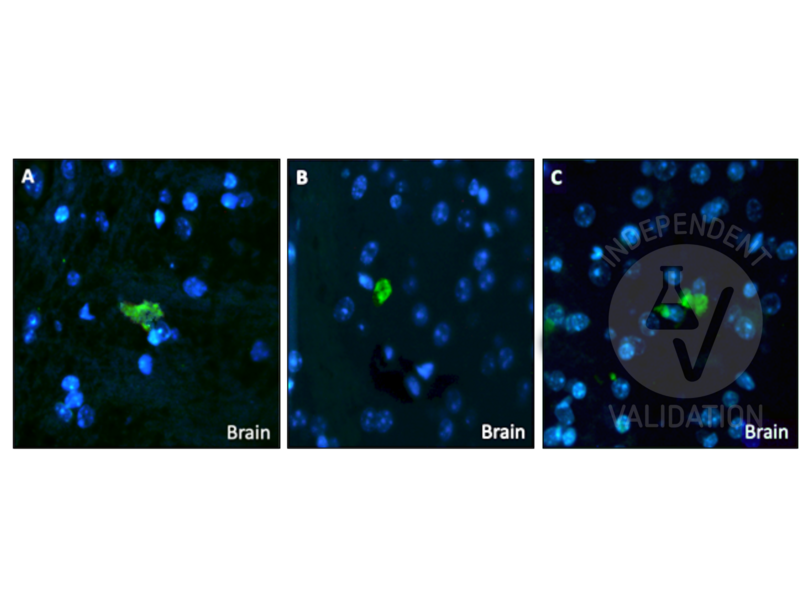
The beta Amyloid antibody (Amyloid beta) (N-Term) ABIN95037 works in IHC-P, especially at higher concentrations (1:20 and 1:50), and without the use of any antigen retrieval treatment.
- Anticorps primaire
- ABIN95037
- Anticorps secondaire
- goat anti-rabbit AF488-conjugated antibody (Invitrogen by Thermo Fisher Scientific, A11034, lot 1971418)
- Full Protocol
- Perfuse mice with paraformaldehyde 4% in 0.1 M phosphate buffer pH 7.4 and post-fix in the same fixative for an additional 2 h at RT.
- Wash, dehydrate, and embed samples in paraffin wax.
- Wash several times with 0.01 M PBS.
- Cut intestines and brain with a microtome into 6µm sections and mount on glass slides.
- After paraffin removal, incubate sections for 1 h at RT in PBS containing 1% albumin from chicken egg white (Sigma, A5378) and 0.3% Triton-X-100 (BioRad, 161-0407, lot 00583) to block non-specific binding sites.
- Incubate sections with primary anti-beta amyloid (N-Term) (antibodies Online, ABIN95037, lot 42581) diluted 1:20, 1:50, 1:100, and 1:200 in 0.1 M PBS-BSA-PLL ON at RT.
- Wash sections 3x 5 min with 0.01 M PBS.
- Incubate sections with secondary goat anti-rabbit AF488-conjugated antibody (Invitrogen by Thermo Fisher Scientific, A11034, lot 1971418) diluted 1:500 in 0.1 M PBS for 1 h at RT.
- Wash sections 3x 5 min with 0.01M PBS.
- Mount specimens in Fluoroshield (Sigma, F6182, lot MKCB0153V).
- Acquire images with a fluorescence microscope and appropriate filter settings for AF488, e.g. Leica DM 6000B fluorescence microscope equipped with a digital camera at 40x magnification.
- Notes
Antigen retrieval treatment was also tested. In this case, sections were processed for microwave antigen retrieval for 10 min (95-100 °C) in 10 mM sodium citrate buffer (pH 6.0). After 20 min of spontaneous cooling, sections were washed twice for 5 min with distilled water and for 5 min with PBS.
Validation #104424 (Immunohistochemistry)
 Validation Images
![Staining of beta-amyloid positive cells in the adult mouse brain using ABIN95037 at 40x magnification.]() Staining of beta-amyloid positive cells in the adult mouse brain using ABIN95037 at 40x magnification.
Protocole
Staining of beta-amyloid positive cells in the adult mouse brain using ABIN95037 at 40x magnification.
Protocole -
-
Format
- Liquid
-
Buffer
-
Buffer: 0.02 M Potassium Phosphate, 0.15 M Sodium Chloride, pH 7.2
Stabilizer: None
Preservative: 0.01 % (w/v) Sodium Azide -
Agent conservateur
- Sodium azide
-
Précaution d'utilisation
- This product contains Sodium azide: a POISONOUS AND HAZARDOUS SUBSTANCE which should be handled by trained staff only.
-
Stock
- 4 °C,-20 °C
-
Stockage commentaire
- Store vial at -20° C prior to opening. Aliquot contents and freeze at -20° C or below for extended storage. Avoid cycles of freezing and thawing. Centrifuge product if not completely clear after standing at room temperature. This product is stable for several weeks at 4° C as an undiluted liquid. Dilute only prior to immediate use.
-
Date de péremption
- 12 months
-
-
-
: "N-terminal EFRH sequence of Alzheimer's beta-amyloid peptide represents the epitope of its anti-aggregating antibodies." dans: Journal of neuroimmunology, Vol. 88, Issue 1-2, pp. 85-90, (1998) (PubMed).
-
: "N-terminal EFRH sequence of Alzheimer's beta-amyloid peptide represents the epitope of its anti-aggregating antibodies." dans: Journal of neuroimmunology, Vol. 88, Issue 1-2, pp. 85-90, (1998) (PubMed).
-
- APP (Amyloid beta (A4) Precursor Protein (APP))
-
Autre désignation
- APP
-
Sujet
- Background: Beta amyloid, often abbreviated as A-beta, is a protein that builds up in the brains of persons with Alzheimer's disease, collecting in clumps called plaques or senile plaques. While some researchers question whether beta amyloid is the cause of the dementia, most agree that it is involved in the disruption of thinking that is a hallmark of the disease. In some cases of familial Alzheimer's disease, mutations in genes for the proteins called the presenilins lead to increased production of amyloid. Researchers have been looking at how presenilin-1 in particular contributes to the excess buildup of beta amyloid. Presenilin-1 apparently acts to increase the activity of gamma-secretase, an enzyme that changes a normal protein (amyloid precursor protein or APP) into beta amyloid itself. Furthermore, presenilin-1 might be gamma-secretase. Anti-Beta Amyloid Antibody is useful for researchers interested in TLR signaling and Alzheimer's research.
-
ID gène
- 351
-
NCBI Accession
- NP_000475
-
UniProt
- P05067
-
Pathways
- Caspase Cascade in Apoptosis, EGFR Signaling Pathway, Transition Metal Ion Homeostasis, Skeletal Muscle Fiber Development, Toll-Like Receptors Cascades, Feeding Behaviour
Antigène
-