IL-8 anticorps
 (1 reference)
 (1 validation)
Aperçu rapide pour IL-8 anticorps (ABIN1724413)
Antigène
Voir toutes IL-8 (IL8) AnticorpsReactivité
Hôte
Clonalité
Conjugué
Application
-
-
Specificité
- Reacts with human IL-8
-
Purification
- Purified
-
Immunogène
- Recombinant protein corresponding to full length IL8
-
Isotype
- IgG1
-
-
anti-Interleukin 8 (IL8) (AA 23-101) antibody
IL8 Reactivité: Cheval WB, IHC, IP, ICC Hôte: Lapin Polyclonal unconjugated
anti-Interleukin 8 (IL8) (AA 21-99) antibodyIL8 Reactivité: Humain WB, IHC Hôte: Lapin Polyclonal unconjugated
anti-Interleukin 8 (IL8) (AA 72-99), (C-Term) antibodyIL8 Reactivité: Humain WB, FACS, IHC (p), IF Hôte: Lapin Polyclonal RB20676 unconjugated
anti-Interleukin 8 (IL8) (AA 72-99) antibodyIL8 Reactivité: Humain WB, IHC, ELISA, FACS, IF Hôte: Lapin Polyclonal unconjugated
anti-Interleukin 8 (IL8) antibodyIL8 Reactivité: Humain WB, ELISA, Neut Hôte: Lapin Polyclonal unconjugated
anti-Interleukin 8 (IL8) (AA 23-101) antibodyIL8 Reactivité: Chien WB, IHC Hôte: Lapin Polyclonal unconjugated
anti-Interleukin 8 (IL8) (AA 23-101) antibodyIL8 Reactivité: Chien WB, IHC, IP, ICC Hôte: Souris Monoclonal C4 unconjugated
anti-Interleukin 8 (IL8) (AA 28-99) antibodyIL8 Reactivité: Humain WB, IHC, IP, ICC Hôte: Lapin Polyclonal unconjugated
anti-Interleukin 8 (IL8) (AA 23-99) antibodyIL8 Reactivité: Humain WB, IHC, ELISA Hôte: Lapin Polyclonal unconjugated
anti-Interleukin 8 (IL8) (C-Term) antibodyIL8 Reactivité: Humain WB, ELISA, IHC (p) Hôte: Lapin Polyclonal unconjugated
-
-
Indications d'application
-
Working dilution: Optimal dilution should be determined by the end user.
The following are guidelines only:
IHC-P (5 μg/mL) WB (1:1000) -
Restrictions
- For Research Use only
-
-
- by
- HIK Hannover
- No.
- #100789
- Date
- 31.05.2017
- Antigène
- IL8
- Numéro du lot
- Application validée
- Immunohistochemistry
- Contrôle positif
- Formalin fixed and plastic embedded human liver, testicle, and tonsil tissue sections
- Contrôle négative
- No primary antibody
- Conclusion
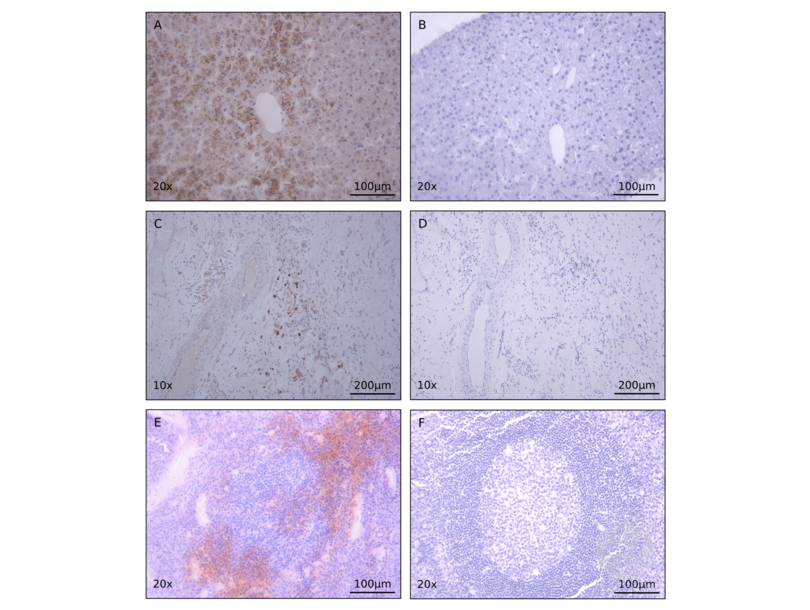
- Passed. The IL8 antibody ABIN1724413 specifically labels the targeted antigen in human liver, testicle, and tonsil sections in IHC. No signal was detected in tonsil negative control tissue sections and the no primary antibody negative controls.
- Anticorps primaire
- ABIN1724413
- Anticorps secondaire
- Histofine Simple Stain MAX PO (M) Anti-Mouse (Medac Diagnostika, 414132F, lot no H1608)
- Full Protocol
- Disect tissue and fix in 4% buffered formalin for >24h at RT.
- Plastification in Technovit 9100 plastic embedding system (Heraeus Kulzer) according to manufactuer’s recommencations.
- Sectioning into 5µm sections on a rotary microtome (Reichert Jung, 1140/Autocut).
- Deplastify and rehydrate tissue through graded xylene and graded alcohol series:
- xylene for 20min.
- MEA (2-Methoxyethyl)acetat zur Synthese (Merck, 8.06061.1000) 2x 20min.
- 100% ethanol for 1min.
- 95% ethanol for 1min.
- 70% ethanol for 1min.
- H2O for 2min.
- distilled H2O 2min.
- Heat induced epitope retrieval in high pH Trilogy buffer (Medac Diagnostika, 920P-07, lot 1622912A) ON at 60°C in an oven (Memmert, UNB 200).
- Quench sections in in ice cold distilled H2O 2min.
- Adjust sections with wash buffer (Medac Diagnostika, B1-30A, lot no 161102001) 5min at RT.
- Incubate sections with primary Interleukin 8 antibody (antibodies-online, ABIN1724413) diluted 1:400 in dilution buffer (Medac Diagnostika, B1-31C, lot no 161205001) for 30min at RT. Includeno primaryantibody negative controls.
- Rinse sections 3x 5min with wash buffer. Keep negative controls in a separate container.
- Block endogenous peroxidase with Peroxide Block RTU (Medac Diagnostika, 925B-09, lot no 161103001) for 10min at RT.
- Rinse sections 3x 5min with wash buffer.
- Incubate sections with Histofine Simple Stain MAX PO (M) Anti-Mouse (Medac Diagnostika, 414132F, lot no H1608) for 30min at RT.
- Rinse sections 3x 5min with wash buffer.
- Incubate sections with Bright DAB (Medac Diagnostika, BS04-110, lot no 160523) for 10min at RT.
- Rinse sections in distilled H2O.
- Counterstain with Mayers Haematoxylin (Leica, 3801582E, lot no3801582E) 5min at RT.
- Dehydrate in fresh ethanol:
- 95% ethanol twice for 2min.
- 99.5% ethanol twice for 2min.
- Xylene twice for 2min.
- Mount sections with Celltexx mounting medium (Engelbrecht, 19360, lot no 1716047).
- Dry sections in a ventilated place.
- Image acquisition on a Leica Microsystems DM 1000 light microscope with a DFC 320 digital camera. Magnification tonsil sections 40x, liver sections 10x and 20x, testicle sections 10x.
- Notes
- Immunostaining pattern of human liver, testicle, and tonsil with ABIN1724413 is consistent with published data.
Validation #100789 (Immunohistochemistry)
 Validation Images
![Immunostaining of IL8 in human liver liver (A), testicle (C), and tonsil sections (D) using ABIN1724413 compared to unstained sections of the same tissues (B, D, F). Magnification factors and the respective scale are indicated.]() Immunostaining of IL8 in human liver liver (A), testicle (C), and tonsil sections (D) using ABIN1724413 compared to unstained sections of the same tissues (B, D, F). Magnification factors and the respective scale are indicated.
Protocole
Immunostaining of IL8 in human liver liver (A), testicle (C), and tonsil sections (D) using ABIN1724413 compared to unstained sections of the same tissues (B, D, F). Magnification factors and the respective scale are indicated.
Protocole -
-
Format
- Liquid
-
Concentration
- 1 mg/mL
-
Buffer
- Citrate-Tris-HCl buffer, pH 7.0, 0.02 % Proclin 300
-
Agent conservateur
- ProClin
-
Précaution d'utilisation
- This product contains ProClin: a POISONOUS AND HAZARDOUS SUBSTANCE which should be handled by trained staff only.
-
Stock
- 4 °C/-20 °C
-
Stockage commentaire
- Short term 4°C, long term aliquot and store at -20°C, avoid freeze thaw cycles.
-
-
-
: "Commensal and pathogenic biofilms differently modulate peri-implant oral mucosa in an organotypic model." dans: Cellular microbiology, pp. e13078, (2019) (PubMed).
-
: "Commensal and pathogenic biofilms differently modulate peri-implant oral mucosa in an organotypic model." dans: Cellular microbiology, pp. e13078, (2019) (PubMed).
-
- IL-8 (IL8) (Interleukin 8 (IL8))
-
Autre désignation
- IL-8
-
Sujet
- IL-8 is a chemotactic factor that attracts neutrophils, basophils, and T-cells, but not monocytes. It is also involved in neutrophil activation. It is released from several cell types in response to an inflammatory stimulus. IL-8(6-77) has a 5-10-fold higher activity on neutrophil activation, IL-8(5-77) has increased activity on neutrophil activation and IL-8(7-77) has a higher affinity to receptors CXCR1 and CXCR2 as compared to IL-8(1-77), respectively.
-
ID gène
- 3576
-
Pathways
- Signalisation TLR, Cellular Response to Molecule of Bacterial Origin, Regulation of G-Protein Coupled Receptor Protein Signaling, ER-Nucleus Signaling, Hepatitis C, Autophagy
Antigène
-