E-cadherin anticorps (AA 375-631)
 (4 références)
 (1 validation)
Aperçu rapide pour E-cadherin anticorps (AA 375-631) (ABIN1858334)
Antigène
Voir toutes E-cadherin (CDH1) AnticorpsReactivité
Hôte
Clonalité
Conjugué
Application
-
-
Épitope
- AA 375-631
-
Fonction
- Polyclonal Antibody to E-cadherin
-
Specificité
- The antibody is a rabbit polyclonal antibody raised against E-cadherin. It has been selected for its ability to recognize E-cadherin in immunohistochemical staining and western blotting.
-
Purification
- Antigen-specific affinity chromatography followed by Protein A affinity chromatography
-
Immunogène
- Recombinant E-cadherin corresdonding to Phe375~Thr631 (Accession # C6EVT4) with N-terminal His and GST Tag
-
Isotype
- IgG
-
-
anti-Cadherin 1, Type 1, E-Cadherin (Epithelial) (CDH1) (AA 401-500) antibody
CDH1 Reactivité: Humain, Souris, Rat WB, FACS, ELISA, ICC, IHC (p), IF (p), IHC (fro), IF (cc) Hôte: Lapin Polyclonal unconjugated
anti-Cadherin 1, Type 1, E-Cadherin (Epithelial) (CDH1) antibodyKO Validated CDH1 Reactivité: Humain WB, IF, IP, ICC, IHC (p), IHC (wm) Hôte: Lapin Polyclonal unconjugated
anti-Cadherin 1, Type 1, E-Cadherin (Epithelial) (CDH1) (C-Term) antibodyCDH1 Reactivité: Humain, Souris, Rat WB, IHC, IF, ELISA, ICC Hôte: Lapin Polyclonal unconjugated
anti-Cadherin 1, Type 1, E-Cadherin (Epithelial) (CDH1) (AA 381-480) antibodyCDH1 Reactivité: Humain WB, ELISA, IHC (p), PLA Hôte: Souris Monoclonal 3F4 unconjugated
anti-Cadherin 1, Type 1, E-Cadherin (Epithelial) (CDH1) antibodyCDH1 Reactivité: Humain, Souris, Rat, Porc, Singe, Poulet, Chien, Lapin, Boeuf (Vache), Cheval, Cobaye, Avian, Cat, Âne, Chévre, Hamster, Mouton WB, IF, IHC (p), IHC (fro) Hôte: Chèvre Polyclonal unconjugated
anti-Cadherin 1, Type 1, E-Cadherin (Epithelial) (CDH1) antibodyCDH1 Reactivité: Humain, Souris, Rat, Porc, Singe, Poulet, Chien, Lapin, Boeuf (Vache), Cheval, Cobaye, Avian, Cat, Âne, Chévre, Hamster, Mouton WB, IF, IHC (p), IHC (fro) Hôte: Chèvre Polyclonal unconjugated
anti-Cadherin 1, Type 1, E-Cadherin (Epithelial) (CDH1) (AA 810-890) antibodyCDH1 Reactivité: Humain, Souris, Rat WB, IF, ELISA, IHC (p) Hôte: Lapin Polyclonal unconjugated
anti-Cadherin 1, Type 1, E-Cadherin (Epithelial) (CDH1) antibodyCDH1 Reactivité: Humain WB, IHC, IF, StM, ISt Hôte: Souris Monoclonal CDH1-1525 unconjugated
anti-Cadherin 1, Type 1, E-Cadherin (Epithelial) (CDH1) (AA 700-800) antibodyCDH1 Reactivité: Humain WB, IHC, IF Hôte: Lapin Polyclonal unconjugated
anti-Cadherin 1, Type 1, E-Cadherin (Epithelial) (CDH1) (AA 155-707) antibodyCDH1 Reactivité: Humain WB, FACS, IF, ELISA Hôte: Souris Monoclonal 9H2D3 unconjugated
-
-
Indications d'application
- Western blotting: 0.01-5 μg/mL,Immunohistochemistry: 5-50 μg/mL,Immunocytochemistry: 5-50 μg/mL,Optimal working dilutions must be determined by end user.
-
Commentaires
-
The thermal stability is described by the loss rate. The loss rate was determined by accelerated thermal degradation test, that is, incubate the protein at 37°C for 48h, and no obvious degradation and precipitation were observed. The loss rate is less than 5% within the expiration date under appropriate storage condition.
-
Restrictions
- For Research Use only
-
-
- by
- Sackler School of Biomedical Sciences, Tufts University School of Medicine
- No.
- #101345
- Date
- 05.06.2017
- Antigène
- E-cadherin
- Numéro du lot
- A20160427539
- Application validée
- Immunofluorescence
- Contrôle positif
- porcine unerupted tooth buds, dental epithelium
- Contrôle négative
- porcine unerupted tooth buds, mesenchym
- Conclusion
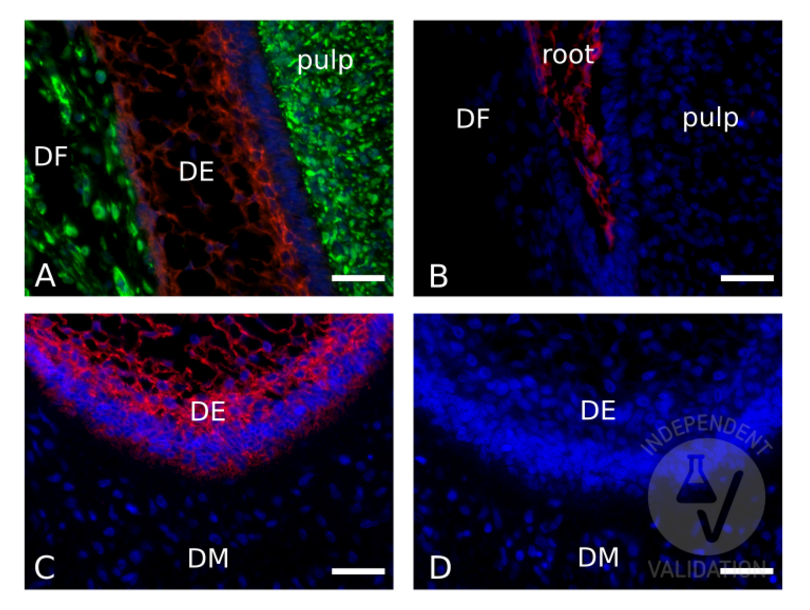
- Passed. The E-caherin antibody ABIN1858334 specifically labels epithelial tissues in porcine unerupted tooth buds in immunofluorescence, consistent with the expression pattern of E-cadherin.
- Anticorps primaire
- ABIN1858334
- Anticorps secondaire
- goat anti-rabbit AF568 conjugated antibody (ThermoFisher Scientific, A11011, lot 1778025)
- Full Protocol
- Harvest unerupted tooth buds from 5 month old pig jaws and wash 3x in phosphate bufferend saline (PBS) (Boston Bioproducts, BM-220).
- Fix tooth buds in 10% Formalin (Fisher Scientific, 23-245-685) for 24h.
- Wash 3x in PBS.
- Place tooth buds through graded ethanol seris for 6h at each concentration: 50%, 70%, 80%, 90%, 100%, 100%, 100%.
- Place tooth buds in 3x 2h in 100% xylene.
- Place in molten paraffin 2x (TissuePrep 2 Paraffin, Fisher, T555-2) 12h.
- Embed tooth buds in paraffin and cool on a 4°C cold plate for 1h.
- Let set ON at RT.
- Cut blocks into 6µm sections using a microtome (ThermoFisher Scientific, HM 355S).
- Use a tissue floating bath to mount sections onto microscope slides.
- Heat sections on a hot plate for 1h at 45°C for 1h then ON at 55°C.
- Deparaffinize slide 2x 5 min in 100% xylene.
- Rehydrate sections in graded ethanol series for 2min for each concentration: 100%, 95%, 70%, 50%.
- Place slide in H2O for 5min.
- Transfer slide to a plastic holder filled with warmed 10mM Citric Acid Solution (made from sodium citrate monobasic; Sigma, 71497) pH6.0 and incubate in a steamer for 20min.
- Cool submerged slide on benchtop for 30min.
- Wash slide 3x 5min in PBS.
- Create a hydrophobic barrier on slide around sections with PAP-pen (Vector Labs, H-4000, lot 5138).
- Place slide in a humidified chamber and block with 5% BSA for 20min at 37°C.
- Gently remove BSA by tapping slide.
- Incubate sections with primary antibody
- rabbit anti-pig E-cadherin antibody (antibodies-online, ABIN1858334, lot A20160408626) diluted to 1:40 in 1% BSA or
- and mouse anti-pig Vimentin (Santa Cruz Biotechnology, SC-6260, lot G2814) diluted to 1:500 in 1% BSA for 1h at RT.
- A no primary antibody negative control was incubated in parallel in 1% BSA.
- Wash in slide 3x 5min in PBS.
- Incubate sections in secondary antibodies
- goat anti-rabbit AF568 conjugated antibody (ThermoFisher Scientific, A11011, lot 1778025) diluted to 1:100 in 1% BSA and
- goat anti-mouse AF488 conjugated antibody (ThermoFisher Scientific, A11001, lot 1752514 ) diluted to 1:100 in 1% BSA for 1h at RT.
- Wash in slide 3x 5min in PBS.
- Add approximately 10μL of Hard Set Mounting Medium with DAPI (Vector Labs, H-1500, lot ZC1221) for each section and mount cover slip.
- Notes
Validation #101345 (Immunofluorescence)
 Validation Images
![A. ABIN1858334 stains the dental epithelium (DE, red) in pig tooth buds whereas the dental follicle (DF) and the pulp – labeled with the mesenchymal marker Vimentin (green) – remain unstained. B. Staining of the dental epithelial root tissue with ABIN1858334. C. Immunostaining of the DE with ABIN1858334. No staining of of dental mesenchym (DM) by ABIN1858334 or of the dental epithelium when using the secondary antibody alone (panle D).
40X, Scale Bar 50μm, 150 Resolution]() A. ABIN1858334 stains the dental epithelium (DE, red) in pig tooth buds whereas the dental follicle (DF) and the pulp – labeled with the mesenchymal marker Vimentin (green) – remain unstained. B. Staining of the dental epithelial root tissue with ABIN1858334. C. Immunostaining of the DE with ABIN1858334. No staining of of dental mesenchym (DM) by ABIN1858334 or of the dental epithelium when using the secondary antibody alone (panle D).
40X, Scale Bar 50μm, 150 Resolution
Protocole
A. ABIN1858334 stains the dental epithelium (DE, red) in pig tooth buds whereas the dental follicle (DF) and the pulp – labeled with the mesenchymal marker Vimentin (green) – remain unstained. B. Staining of the dental epithelial root tissue with ABIN1858334. C. Immunostaining of the DE with ABIN1858334. No staining of of dental mesenchym (DM) by ABIN1858334 or of the dental epithelium when using the secondary antibody alone (panle D).
40X, Scale Bar 50μm, 150 Resolution
Protocole -
-
Format
- Liquid
-
Concentration
- 0.33 mg/mL
-
Buffer
- PBS, pH 7.4, containing 0.02 % Sodium azide, 50 % glycerol.
-
Agent conservateur
- Sodium azide
-
Précaution d'utilisation
- WARNING: Reagents contain sodium azide. Sodium azide is very toxic if ingested or inhaled. Avoid contact with skin, eyes, or clothing. Wear eye or face protection when handling. If skin or eye contact occurs, wash with copious amounts of water. If ingested or inhaled, contact a physician immediately. Sodium azide yields toxic hydrazoic acid under acidic conditions. Dilute azide-containing compounds in running water before discarding to avoid accumulation of potentially explosive deposits in lead or copper plumbing.
-
Conseil sur la manipulation
- Avoid repeated freeze-thaw cycles.
-
Stock
- 4 °C,-20 °C
-
Stockage commentaire
- Store at 4°C for frequent use. Stored at -20°C in a manual defrost freezer for two year without detectable loss of activity. Avoid repeated freeze-thaw cycles.
-
Date de péremption
- 24 months
-
-
-
: "Swallowable expandable fibrous capsules for nonendoscopic sampling of esophageal cells." dans: Science advances, Vol. 11, Issue 46, pp. eaeb3892, (2025) (PubMed).
: "In vivo bioengineered tooth formation using decellularized tooth bud extracellular matrix scaffolds." dans: Stem cells translational medicine, Vol. 14, Issue 2, (2025) (PubMed).
: "Developing a biomimetic tooth bud model." dans: Journal of tissue engineering and regenerative medicine, (2017) (PubMed).
: "Dental cell sheet biomimetic tooth bud model." dans: Biomaterials, Vol. 106, pp. 167-79, (2016) (PubMed).
-
: "Swallowable expandable fibrous capsules for nonendoscopic sampling of esophageal cells." dans: Science advances, Vol. 11, Issue 46, pp. eaeb3892, (2025) (PubMed).
-
- E-cadherin (CDH1) (Cadherin 1, Type 1, E-Cadherin (Epithelial) (CDH1))
-
Autre désignation
- E-cadherin
-
Sujet
- CDHE, CD324, CDH1, Arc1, ECAD, CDH-E, E-CAD, LCAM, UVO, Cadherin 1 Type 1, Uvomorulin, E-Cadherin, Calcium-Dependent Adhesion Protein, Epithelial, Liver Cell Adhesion Molecule
-
Pathways
- Signalisation WNT, Sensory Perception of Sound, Cell-Cell Junction Organization, Tube Formation
Antigène
-