HMGB1 anticorps (N-Term)
 (1 validation)
Aperçu rapide pour HMGB1 anticorps (N-Term) (ABIN2787911)
Antigène
Voir toutes HMGB1 AnticorpsReactivité
Hôte
Clonalité
Conjugué
Application
-
-
Épitope
- N-Term
-
Séquence
- QTCREEHKKK HPDASVNFSE FSKKCSERWK TMSAKEKGKF EDMAKADKAR
-
Homologie
- Cow: 100%, Dog: 100%, Guinea Pig: 100%, Horse: 100%, Human: 100%, Mouse: 100%, Rabbit: 100%, Rat: 100%, Zebrafish: 93%
-
Attributs du produit
- This is a rabbit polyclonal antibody against HMGB1. It was validated on Western Blot.
-
Purification
- Affinity Purified
-
Immunogène
- The immunogen is a synthetic peptide directed towards the N terminal region of human HMGB1
-
-
anti-High Mobility Group Box 1 (HMGB1) (AA 75-170) antibody
HMGB1 Reactivité: Humain, Souris, Rat WB, ELISA, FACS, IHC (p), IF (cc), IF (p), IHC (fro) Hôte: Lapin Polyclonal unconjugated
anti-High Mobility Group Box 1 (HMGB1) antibodyKO Validated HMGB1 Reactivité: Humain WB, IHC, IF, ICC, IHC (p), IHC (wm), IHC (ff) Hôte: Lapin Polyclonal unconjugated
anti-High Mobility Group Box 1 (HMGB1) (AA 1-90) antibodyHMGB1 Reactivité: Humain WB, ELISA, IF, IHC (p) Hôte: Souris Monoclonal 2F6 unconjugated
anti-High Mobility Group Box 1 (HMGB1) (AA 9-163) antibodyHMGB1 Reactivité: Humain WB, IHC Hôte: Lapin Polyclonal unconjugated
anti-High Mobility Group Box 1 (HMGB1) (AA 1-215) antibodyHMGB1 Reactivité: Souris WB, IHC, IF, ICC Hôte: Lapin Polyclonal unconjugated
anti-High Mobility Group Box 1 (HMGB1) (AA 1-215) antibodyHMGB1 Reactivité: Rat WB, IHC Hôte: Lapin Polyclonal unconjugated
anti-High Mobility Group Box 1 (HMGB1) (AA 1-215) antibodyHMGB1 Reactivité: Humain WB, ELISA, IF, IHC (p) Hôte: Souris Monoclonal 1E6-E10 unconjugated
anti-High Mobility Group Box 1 (HMGB1) (AA 1-215) antibodyHMGB1 Reactivité: Humain WB, ELISA, IF, IHC (p) Hôte: Souris Monoclonal 1D5 unconjugated
anti-High Mobility Group Box 1 (HMGB1) (AA 124-154), (C-Term) antibodyHMGB1 Reactivité: Humain, Souris, Rat WB, IHC, IF, ICC, FACS Hôte: Lapin Polyclonal unconjugated
anti-High Mobility Group Box 1 (HMGB1) (AA 1-215) antibodyHMGB1 Reactivité: Humain WB, IF, ICC Hôte: Souris Monoclonal C4 unconjugated
-
-
Indications d'application
- Optimal working dilutions should be determined experimentally by the investigator.
-
Commentaires
-
Antigen size: 215 AA
-
Restrictions
- For Research Use only
-
-
- by
- Lewis Lab, Department of Biology, College of Arts and Sciences, Syracuse University
- No.
- #103662
- Date
- 05.12.2019
- Antigène
- HMGB1
- Numéro du lot
- QC29977-40568
- Application validée
- Western Blotting
- Contrôle positif
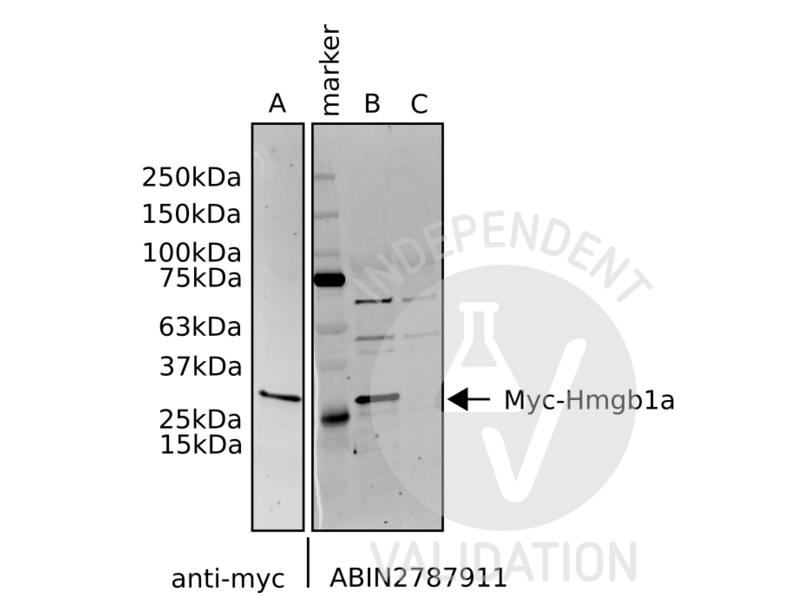
Zebrafish embryos injected with Myc-Hmgb1a
- Contrôle négative
Uninjected embryos
- Conclusion
Passed. ABIN2787911 specifically recognizes Myc-Hmgb1a in embryos overexpressing this construct.
- Anticorps primaire
- ABIN2787911
- Anticorps secondaire
- IRDye 800CW Goat anti-Rabbit IgG Secondary Antibody (LI-COR, 925-32211, lot C80925-01)
- Full Protocol
- Harvest >100 zebrafish embryos from wild type parents.
- Inject >50 embryos with 1ng mRNA encoding a Myc-tagged Hmgb1a construct. Leave the remainder of embryos uninjected as negative controls.
- Grow embryos to 6h post-fertilization.
- Enzymatically dechorionate all surviving, fertile embryos with 1mg/ml Pronase solution.
- De-yolk embryos mechanically by pipetting up and down several times, spinning down cells, and washing away soluble yolk proteins.
- Lyse each group of embryos mechanically with micropestle in 1µl per embryo of lysis buffer (50mM Tris-HCl pH8.0, 150mM NaCl, 1mM EDTA, 1% Triton X-100, 1x Roche EDTA-free protease inhibitor cocktail, 1mM PMSF).
- Spin down debris and transfer lysates to fresh tubes.
- Mix lysates 1:1 with 2x Laemmli SDS sample buffer and incubate 5min at 95°C.
- Load 20µl of resulting mix per well of 4-20% Mini-PROTEAN TGX precast protein gel (Bio-Rad, 456-1095, lot 64268988) in a Mini-PROTEAN Electrophoresis Cell and run for 40min at 200V.
- Activate 0.45µm PVDF membrane (Millipore, product IPVH00010, lot K3HA8233EK) with methanol. Transfer proteins to membrane with transfer buffer (25mM Tris-HCl pH8.3, 192mM glycine, 20% v/v methanol) for 1h at 100V.
- Rinse membrane with water, then incubate 2min in PBS.
- Block the membrane with Odyssey Blocking Buffer (LI-COR, P/N 927-40000) 1h at RT with shaking.
- Incubate with either of primary
- rabbit anti-HMGB1 antibody (antibodies-online, ABIN2787911, lot QC29977-40568) diluted 1:1000 in Odyssey Blocking Buffer (LI-COR, product no, lot no) containing 0.2% Tween 20 ON at 4°C with shaking.
- mouse anti-Myc antibody (ThermoFisher Scientific, MA1-980, lot NJ17123) diluted 1:1000 in Odyssey Blocking Buffer (LI-COR, product no, lot no) containing 0.2% Tween 20 ON at 4°C with shaking.
- Wash membrane 5x 5min each with PBST (PBS, 0.1% Tween 20).
- Incubate with secondary
- IRDye 800CW Goat anti-Rabbit IgG Secondary Antibody (LI-COR, 925-32211, lot C80925-01) diluted 1:15000 in Odyssey Blocking Buffer containing 0.2% Tween 20 and 0.01% w/v SDS 1h at RT with shaking.
- IRDye 800CW Goat anti-Mouse IgG Secondary Antibody (LI-COR, 925-32210, lot C70712-11) diluted 1:15000 in Odyssey Blocking Buffer containing 0.2% Tween 20 and 0.01% w/v SDS 1h at RT with shaking.
- Wash membrane 5x 5min each with PBST.
- Rinse membrane with PBS then hang to dry.
- Once dry, scan the membrane with LI-COR Odyssey CLX Scanner.
- Notes
The Hmgb1 antibody ABIN2787911 reveals a protein of the expected molecular weight of the overexpressed Myc-Hmgb1a construct in the injected lysate. A Myc-tag antibody also detects this protein at the same size in the same lysate. This band is not detected by ABIN2787911 in an uninjected control lysate.
- ABIN2787911 also detects a faint band (or set of overlapping bands) at the expected size of endogenous Hmgb1a and Hmgb1b in both injected and uninjected lysates, but this band is weaker than several other non-specific bands.
- Protein amounts of Hmgb1a and Hmgb1a at this stage are unknown, so detection of these endogenous proteins was not necessarily guaranteed. Both corresponding mRNAs are expressed at this stage, so we predicted we might be able to detect the encoded proteins.
- Expected sizes of target antigens: are 25.1 kDa for pCS2-Myc-Hmgb1a, 23.7kDa for endogenous Hmgb1a: 23.7kDa, and 22.9kDa for endogenous Hmgb1b: 22.9kDa.
Validation #103662 (Western Blotting)
 Validation Images
![]() Protocole
Protocole -
-
Format
- Liquid
-
Concentration
- Lot specific
-
Buffer
- Liquid. Purified antibody supplied in 1x PBS buffer with 0.09 % (w/v) sodium azide and 2 % sucrose.
-
Agent conservateur
- Sodium azide
-
Précaution d'utilisation
- This product contains Sodium azide: a POISONOUS AND HAZARDOUS SUBSTANCE which should be handled by trained staff only.
-
Conseil sur la manipulation
- Avoid repeated freeze-thaw cycles.
-
Stock
- -20 °C
-
Stockage commentaire
- For short term use, store at 2-8°C up to 1 week. For long term storage, store at -20°C in small aliquots to prevent freeze-thaw cycles.
-
-
- HMGB1 (High Mobility Group Box 1 (HMGB1))
-
Autre désignation
- HMGB1
-
Sujet
-
Extracellular HMGB1 is an activator of human tumor cell migration operating in concert with EGF. HMGB1 encodes a protein that is potentially involved in the regulation of lipogenic and cholesterogenic gene transcription.
Alias Symbols: DKFZp686A04236, HMG1, HMG3, SBP-1
Protein Interaction Partner: AGTRAP, HUWE1, UBC, ASB2, ASB1, ZNF24, MAPK1, HMGA1, ITGA4, FN1, HNF1A, SSRP1, SMARCE1, PSEN1, XPC, XPA, RAD23B, CDK2, TFAP4, TERF2IP, TERF2, HHV8GK18_gp81, SUMO2, FCP1, DNM2, HSPA8, HMGB2, PDIA3, Ccdc15, POU5F1, H3F3A, CREBBP, CDK1, TBP, LRIF1, RASSF4, N
Protein Size: 215 -
Poids moléculaire
- 25 kDa
-
ID gène
- 3146
-
NCBI Accession
- NM_002128, NP_002119
-
UniProt
- P09429
-
Pathways
- Signalisation p53, Regulation of Muscle Cell Differentiation, Skeletal Muscle Fiber Development, Positive Regulation of Endopeptidase Activity, Regulation of Carbohydrate Metabolic Process, Toll-Like Receptors Cascades, Smooth Muscle Cell Migration, Inflammasome
Antigène
-