p53 anticorps (meLys370)
 (1 validation)
Aperçu rapide pour p53 anticorps (meLys370) (ABIN4902067)
Antigène
Voir toutes p53 (TP53) AnticorpsReactivité
Hôte
Clonalité
Conjugué
Application
-
-
Épitope
- meLys370
-
Fonction
- Rabbit polyclonal to p53 (Mono Methyl Lys370).
-
Specificité
- Mono-Methyl-p53 (K370) Polyclonal Antibody detects endogenous levels of p53 around the methylation site of K370 protein.
-
Attributs du produit
- Rabbit Polyclonal to p53 (Mono Methyl Lys370).
-
Purification
- The antibody was affinity-purified from rabbit antiserum by affinity-chromatography using epitope-specific immunogen.
-
Immunogène
- Synthesized peptide derived from human p53 around the methylation site of K370.
-
Isotype
- IgG
-
-
anti-Tumor Protein P53 (TP53) (pSer392) antibody
TP53 Reactivité: Humain, Souris, Rat WB, IHC, ELISA, IF, ICC Hôte: Lapin Polyclonal unconjugated
anti-Tumor Protein P53 (TP53) (N-Term) antibodyTP53 Reactivité: Humain WB, IF, IHC (p), IP, ICC Hôte: Lapin Polyclonal unconjugated
anti-Tumor Protein P53 (TP53) antibodyKO Validated TP53 Reactivité: Humain WB, IF, IHC (p), IP, ICC, ChIP Hôte: Lapin Polyclonal unconjugated
anti-Tumor Protein P53 (TP53) (AA 301-393) antibodyTP53 Reactivité: Humain, Souris, Rat, Chévre WB, ELISA, FACS, IHC (p), ICC, IF (p), IF (cc), IHC (fro) Hôte: Lapin Polyclonal unconjugated
anti-Tumor Protein P53 (TP53) (AA 293-322) antibodyTP53 Reactivité: Humain WB, IF, IHC (p) Hôte: Lapin Polyclonal RB7777 unconjugated
anti-Tumor Protein P53 (TP53) (pSer20) antibodyTP53 Reactivité: Humain, Souris, Rat WB, IHC, ELISA, IF, ICC Hôte: Lapin Polyclonal unconjugated
anti-Tumor Protein P53 (TP53) (acLys319) antibodyTP53 Reactivité: Humain, Souris, Rat WB, IHC, ELISA, IF, ICC Hôte: Lapin Polyclonal unconjugated
anti-Tumor Protein P53 (TP53) (pSer15) antibodyTP53 Reactivité: Humain, Souris, Rat WB, IHC, ELISA, IF, IP, ICC Hôte: Lapin Polyclonal unconjugated
anti-Tumor Protein P53 (TP53) (pSer33) antibodyTP53 Reactivité: Humain, Souris, Rat WB, IHC Hôte: Lapin Polyclonal unconjugated
anti-Tumor Protein P53 (TP53) antibodyTP53 Reactivité: Humain, Souris, Rat, Singe WB, ELISA, IF, IHC (p) Hôte: Lapin Polyclonal unconjugated
-
-
Indications d'application
-
WB 1:500-1:2000
ELISA 1:10000 -
Commentaires
-
Ubiquitous. Isoforms are expressed in a wide range of normal tissues but in a tissue-dependent manner. Isoform 2 is expressed in most normal tissues but is not detected in brain, lung, prostate, muscle, fetal brain, spinal cord and fetal liver. Isoform 3 is expressed in most normal tissues but is not detected in lung, spleen, testis, fetal brain, spinal cord and fetal liver. Isoform 7 is expressed in most normal tissues but is not detected in prostate, uterus, skeletal muscle and breast. Isoform 8 is detected only in colon, bone marrow, testis, fetal brain and intestine. Isoform 9 is expressed in most normal tissues but is not detected in brain, heart, lung, fetal liver, salivary gland, breast or intestine.
-
Restrictions
- For Research Use only
-
-
- by
- Department of Prevention and Therapy of Chronic Diseases, Institute for Advanced Biosciences, CNRS UMR5309
- No.
- #101268
- Date
- 03.08.2017
- Antigène
- p53K370me
- Numéro du lot
- B1001
- Application validée
- Western Blotting
- Contrôle positif
p53, in vitro specifically p53K370me1 methylated using methyltransferase SMYD2
ectopic SMYD-methylated wildtype p53 from 293T cell extracts
- Contrôle négative
p53, in vitro methylated using methyltransferases G9a and SETD8
p53ΔCTD, lacking C-terminal domain containing known methylable lysines
p53K370R, lacking the lysine 370 methylation site, mutated into arginine
- Conclusion
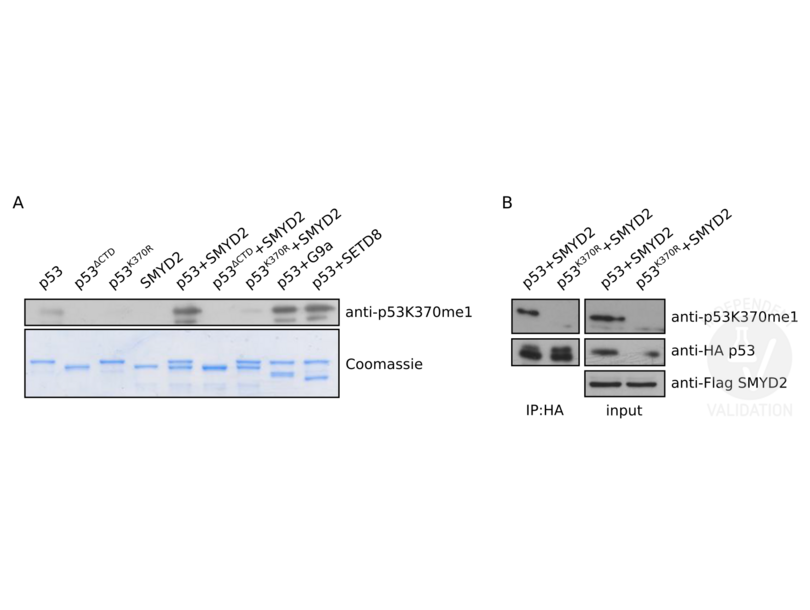
Passed. ABIN4902067 specifically recognizes monomethylated p53K370me1 and to a lesser extent p53Kme1.
- Anticorps primaire
- ABIN4902067
- Anticorps secondaire
- HRP-conjugated goat anti-rabbit or anti-mouse antibody (Biorad)
- Full Protocol
- In vitro p53 methylation assay:
- Clone SMYD2 and p53 from human cDNA library into pGex6p1 vector.
- Perform p53 mutagenesis using QuickChange II site-directed mutagenesis kit (Agilent, 200523).
- Transform vectors into BL21 pLys bacteria (Agilent) and induced protein expression with 0.1mM IPTG in 250mL culture ON at 19°C.
- Purify proteins by GST pulldown and quantify using Bradford assay and Coomassie gel staining.
- For the in vitro methylation assays incubate 1 to 2µg recombinant protein with 1µg of recombinant methyltransferases and 2µCi 3H-AdoMet (American Radiolabelled Chemicals) in buffer containing 50mM Tris-HCl pH8.0, 10% glycerol, 20mM KCl, 5mM MgCl2, and 1mMPMSF at ON at 30°C.
- Resolve the reaction mixture by SDS–PAGE, followed by autoradiography and Coomassie stain (Pierce).
- "In cellulo” p53 methylation assay:
- Subclone SMYD2 and p53 constructs from pGex6p1 vectors into pcagFLAG (SMYD2) or pCDNA3.1HA (p53).
- Transfect plasmids into 293T cells using Lipofectamine 2000 (ThermoFisher) according to supplier’s protocol.
- Harvest cells 36h post-transfection to allow methylation of ectopic p53 by SMYD2 in cells.
- Western blot:
- Separate 20µg of each sample on freshly cast SDS-PAGE gel in a gel electrophoresis chamber (BioRad) for 1h at 140V and RT.
- Transfer proteins onto ethanol-activated 0.2µm Hybond PVDF membrane (Amersham) with a semi-dry Trans-Blot Turbo (BioRad) for 30min at 20V.
- Block the membrane using 5% milk in TBS-Tween 0.1% for 1h at RT.
- Incubate the membrane with primary rabbit anti-p53 meLys370 antibody (antibodies-online, ABIN4902067, LOT B1001), mouse anti-HA antibody (Sigma), or mouse anti-Flag tag antibody (Sigma) diluted 1:1000 in 1% BSA TBS-Tween 0.1% ON at 4°C.
- Wash the membrane 3x for 10min in TBS-Tween 0.1%.
- Incubate the membrane with secondary HRP-conjugated goat anti-rabbit or anti-mouse antibody (Biorad) diluted 1:3000 in 1% BSA TBS-Tween 0.1% for 1h at RT.
- Wash the membrane 3x for 10min in TBS-Tween 0.1%.
- Visualize protein bands using ECL RevelBlot intense (Ozyme) and signal detection on Hyperfilm ECL 18 x24cm (Amersham).
- Notes
- Antibody ABIN4902067 recognizes greatly its specific substrate in vitro: it shows a strong signal when SMYD2 is present, implying monomethylation of K370. The signal is lost when using p53K370R and p53ΔCTD mutants. However, ABIN4902067 also recognizes to a lesser extent in vitro other p53 methylation such as p53 K373me1/2 and p53K382me2 caused by G9a and SETD8 respectively.
- The antibody does recognize unmethylated p53 when using a large quantity of the recombinant protein (not shown).
- ABIN4902067 gives a very clean and specific signal when using ectopic p53 from 293T cell extract: only p53 methylated by SMYD2 is detected, not the p53K370R mutant. The antibody can even be used without an initial immunoprecipitation of total p53 as observable in our figure.
- The binding affinity of ABIN4902067 can be ordered as follows: p53K370me1>p53Kme1>>>p53.
Validation #101268 (Western Blotting)
 Validation Images
![A. In vitro methylation assay of wt p53 and the p53K370R and p53ΔCTD mutants by methyltransferases SMYD2, G9a, and SETD8 (upper panel). See experimental notes for details. The lower panel shows a Commassie stain of the gel prior to the immunoblot. B. Western blot of 293T cellular extracts ectopically expressing HA-tag wt p53 or p53K370R in the presence of DYKDDDDK-tagged SMYD2, verified using an DYKDDDDK-tag antibody. In the panels on the left p53 in the lysates was enriched using an HA-tag antibody. WB with an HA-tag antibody reveals immunoprecipitated wt p53 and p53K370R whereas ABIN4902067 reveals specifically SMYD2-methylated wt p53.]() A. In vitro methylation assay of wt p53 and the p53K370R and p53ΔCTD mutants by methyltransferases SMYD2, G9a, and SETD8 (upper panel). See experimental notes for details. The lower panel shows a Commassie stain of the gel prior to the immunoblot. B. Western blot of 293T cellular extracts ectopically expressing HA-tag wt p53 or p53K370R in the presence of DYKDDDDK-tagged SMYD2, verified using an DYKDDDDK-tag antibody. In the panels on the left p53 in the lysates was enriched using an HA-tag antibody. WB with an HA-tag antibody reveals immunoprecipitated wt p53 and p53K370R whereas ABIN4902067 reveals specifically SMYD2-methylated wt p53.
Protocole
A. In vitro methylation assay of wt p53 and the p53K370R and p53ΔCTD mutants by methyltransferases SMYD2, G9a, and SETD8 (upper panel). See experimental notes for details. The lower panel shows a Commassie stain of the gel prior to the immunoblot. B. Western blot of 293T cellular extracts ectopically expressing HA-tag wt p53 or p53K370R in the presence of DYKDDDDK-tagged SMYD2, verified using an DYKDDDDK-tag antibody. In the panels on the left p53 in the lysates was enriched using an HA-tag antibody. WB with an HA-tag antibody reveals immunoprecipitated wt p53 and p53K370R whereas ABIN4902067 reveals specifically SMYD2-methylated wt p53.
Protocole -
-
Format
- Liquid
-
Concentration
- 1 mg/mL
-
Buffer
- Liquid in PBS containing 50 % glycerol, 0.5 % BSA and 0.02 % sodium azide.
-
Agent conservateur
- Sodium azide
-
Précaution d'utilisation
- This product contains Sodium azide: a POISONOUS AND HAZARDOUS SUBSTANCE which should be handled by trained staff only.
-
Conseil sur la manipulation
- Avoid repeated freeze/thaw cycles.
-
Stock
- -20 °C
-
Stockage commentaire
- Store at -20°C, and avoid repeat freeze-thaw cycles.
-
-
- p53 (TP53) (Tumor Protein P53 (TP53))
-
Autre désignation
- p53
-
ID gène
- 7157
-
UniProt
- P04637
-
Pathways
- Signalisation p53, Signalisation MAPK, Signalisation PI3K-Akt, Apoptose, AMPK Signaling, Chromatin Binding, ER-Nucleus Signaling, Positive Regulation of Endopeptidase Activity, Hepatitis C, Protein targeting to Nucleus, Autophagy, L'effet Warburg
Antigène
-